Monday, April 30, 2012

Clues to the Identity of the Fleur-de-lys Maker


The "Fleur-de-lys" Cufflink Maker
Clues to the Identity

Cufflinks of the Fleur-de-lys Maker, circa 1925.

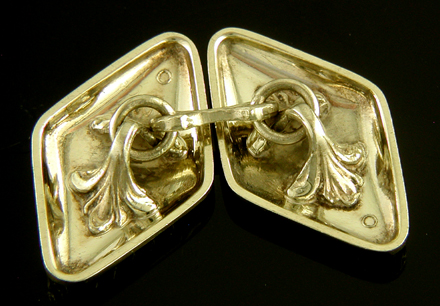
Recently we have been discussing cufflinks created by an unknown maker nicknamed the "Fleur-de-lys Maker". The moniker refers to the distinctive brackets the jeweler used to anchor the cross bars on the reverse of the cufflinks.

In this final post (at least for now) on the Fleur-de-lys Maker I would like to review some of the clues we have to the maker's identity.  Although we have not identified the Fleur-de-lys Maker, these clues offer directions for further research.  Here is what we currently know about this mysterious maker.


Cufflinks of the Fleur-de-lys Maker, circa 1925.

A small body of striking cufflinks is attributed to the Fleur-de-lys Maker. The cufflinks feature richly detailed centers and dramatic borders. They are crafted in platinum and 14kt gold and date from the decades around 1925.

In addition to fleur-de-lys brackets, the cufflinks have distinctive outlines with jutting angles and unsmooth edges. The designs go against the prevailing fashion dicta that cufflinks should have rounded profiles, or at least softened corners, to ease their passage through a buttonhole. The cufflinks of the Fleur-de-lys Maker have a dramatic edginess.


Brackets of the  Fleur-de-lys Maker cufflinks.

The flowing fleur-de-lys brackets have an Art Nouveau feel, while the decorative designs and borders date the cufflinks to the 1920s or early 1930s. A notable cufflink maker during this period  was Charles Keller & Company, a prolific maker of fine cufflinks and other jewels from the 1880s to about 1930.  The firm created a great variety of cufflinks employing a number of linkage and bracket designs. Among them were fleur-de-lys inspired brackets.


Charles Keller  fleur-de-lys brackets.

This raises the possibility that Charles Keller is our mystery maker.  But several factors urge caution.  The Charles  Keller fleur-de-lys brackets are stylized and flattened with more of an Art Deco, than an Art Nouveau, feel. Further, although Charles Keller created many beautiful cufflinks, I have yet to encounter an example of the firm's work which matches the exuberant design and careful craftsmanship of our mystery maker.  Charles Keller & Company remains a possibility, but the link, if any, needs to be further explored.


Possible maker's mark.

A second possible clue to the identity of the Fleur-de-lys Maker is found on the reverse of the marquise-shape cufflinks pictured at the top of this post.  Just outside of the foot of one of the brackets is an indistinctly struck a "C" or "G" inside a diamond-shape cartouche.  The mark is found on only one reverse and appears to be more accidental, than deliberate.

The Providence-based jewelry manufacture S. B. Champlin Company employed a similar mark in the early 1900s.  Established in 1872 by Stanton B. Champlin, the firm created cufflinks and other jewels until 1931.  But any connection between our mystery maker and S.B. Champlin is for now at best tenuous.  The mark appears on only one cufflink, is indistinct (it may be a "G" instead of "C"), and may have been inadvertent.  Other signed examples of the maker's work will need to be found before drawing any conclusions.


Fleur-de-lys Maker cufflinks with black enamel accents, circa 1925.

To recap, we have several directions for future possible research, but still no answer to the question "Who was the Fleur-de-lys Maker?"  I would love to hear from any readers who have similar cufflinks or possible knowledge of the maker.  I will be happy to post any new clues that are uncovered and eventually we will solve this riddle.


For more information about these and other fine cufflinks
please visit the Antique Cufflink Gallery.


Sunday, April 15, 2012

Recent Additions


Recent Additions

While recovering from recent back surgery I have been slower than usual in adding new pieces to the Antique Cufflink and Estate Jewelry Galleries. One piece I have had the pleasure of working with is a wonderful Victorian brooch of Flora, the Goddess of Flowers and Spring. An especially apt jewel for this time of year and, of course Mother's Day. I will be adding more jewels in the next several weeks.


Victorian brooch of Flora, the Goddess of Spring. (J3062)

Goddess of Spring A wonderful hand-painted plaque of Flora bestrewing the early Spring landscape with flowers is set in a radiant gold Victorian brooch in the Classical Revival style. Crafted in 18kt gold, circa 1870.


The above brooch and other fine jewels from the past,
can be found in the Estate Jewelry Gallery


Saturday, March 31, 2012

The Charm of Old Houses


I live in a house built in the late 19th century. One of the joys of living in an older home is the chance to restore and repair architectural features from the past. This gives me an opportunity to "look under the clapboards" and enjoy the craftsmanship of 100 years ago. A pleasure somewhat akin to turning over a pair of antique cufflinks to learn how they were designed and crafted.


Unfortunately, every so often while working on the house I have a mishap. Recently I became entangled in a ladder as it fell to the ground and injured several vertebrae. After surgery last week the prognosis is good with 100% recovery anticipated. The downside is that over the past few weeks I haven't had a chance to follow up on my recent posts about the "Fleur de Lys" cufflink maker. I will pick up on this project next month and hope to post by the end of April.


While falling on top of a ladder is no fun, it does give me an opportunity to post one of my favorite architectural drawings of a late 19th century house. This particular house was built be Charles L. Carrington around 1885. Mr. Carrington was the eponymous founder of Carrington & Company, the celebrated maker of elegant cufflinks and dress sets during the first half of the 20th century.


Please click the above rendering for a larger view.

More about the Carrington house can be found in my post from December, 2009


I hope everyone is enjoying a wonderful early spring.


Thursday, March 15, 2012

Recent Additions


Antique Cufflinks

Recent additions to the Antique Cufflink Gallery include an elegant pair of cameo portrait cuff buttons created by Tiffany & Co., golden pinstripe cufflinks from Carrington & Company, a striking pair of Art Deco cufflinks with zigzag borders, and dramatic fraternal cufflinks of an elk crashing through the tops.


Tiffany cameo cufflinks. (J3850)

Tiffany Cameos Wealthy Victorians often shared cameo portraits with family members and close friends as tokens of endearment. This pair of elegant cuff buttons created by Tiffany & Co. is a wonderful example. Crafted in 18kt rose gold and platinum, circa 1870.


Golden Pinstripes Elegant pinstripe cufflinks created by Carrington & Company. The pinstripe motif rose in popularity with the simpler, linear designs of the late Art Deco period. Crafted in 14kt gold, circa 1930.


Wordley, Allsopp & Bliss white gold and black enamel Art Moderne cufflinks. (J9115)

Deco Zigzag Elegant Art Deco cufflinks with jazzy zigzag enamel borders surrounding mesmerizing centers of concentric circles. Created by Wordley, Allsopp & Bliss in 14kt gold, circa 1930.


http://www.jewelryexpert.com/catalog/Dramatic elk crashing through wall cufflinks. (J9106)

Elk A seven-point elk crashes through the front of these intriguing, wonderfully sculpted cufflinks. These dramatic cufflinks were likely owned by a member of the Benevolent and Protective Order of Elks. Beautifully crafted in 10kt gold, circa 1900.


Estate Jewelry

Recent additions to the Antique and Estate Jewelry Gallery include two beautiful Edwardian jewels - a richly enameled stickpin and an elegant brooch set with an Old European Cut diamond.


Wordley, Allsopp & Bliss guilloche enamel and pearl stickpin. (J9108)

Edwardian Stickpin A white enamel border with gold fleur-de-lys accents surrounds a beautifully guilloched, blue enamel center with a rosy pearl is set in the middle. An elegant stickpin from the Edwardian era. Crafted in 14kt gold circa 1910.


Edwardian brooch set with a sparking Old European Cut diamond. (J3853)

Edwardian Elegance An elegant Edwardian bar pin set with a sparkling Old European Cut diamond. Lace in precious metal. Crafted in 18kt gold, circa 1920.


The above cufflinks and other fine jewels from the past,
can be found in the Antique Cufflink Gallery
and the Estate Jewelry Gallery


Wednesday, February 29, 2012

Investigating Mystery Cufflink Makers


Investigating Mystery Cufflink Makers

Fleur-de-lys bracket maker cufflinks, circa 1925.

Last month I illustrated several pairs of beautiful cufflinks created by an unidentified maker who has been nicknamed the "Fleur-de-lys maker". The cufflinks are characterized by intricately engraved (engine turned) platinum or gold centers, bold borders and dramatic shapes. The moniker refers to the dramatic, flowing brackets the maker used to anchor the cross bars on the reverse of the cufflinks.


Fleur-de-lys maker cufflinks, circa 1925.

Identifying the maker of an unsigned pair of cufflinks can be a daunting task. Fortunately there are several directions in which to look for clues.


1. The first place to look is among signed cufflinks with similar decorative elements and motifs. Cufflinks with similar borders and central motifs may help identify the unknown maker, but caution should be exercised. Popular designs motifs were often embraced by more than one maker. It is not uncommon to come across cufflinks with very similar borders and/or central designs that were created by two different makers.

2. The construction details and linkages of cufflinks can also provide clues. A hundred years ago cufflink makers took great care in designing both the decorative and working parts of their cufflinks. The emphasis was on creating beautiful, sturdy cufflinks that would pass the test of time. An earlier note on the cufflinks of Durand & Company illustrates the care taken in all aspects of cufflink design.

Distinctive linkages, brackets and other working details may suggest the maker of an unsigned pair of cufflinks. But, here again, caution is advised. Bracket, crossbar and bridge designs may have been copied or used by more than one maker or may have been produced by a third manufacturer and sold as "findings" - parts to be used in the assembly of jewelry. The construction details of a cufflink may be a helpful clue in identifying the maker, but it may not be definitive.

3. Browsing through old jewelry catalogs and trade advertising is one of the pleasures of researching antique cufflinks. In addition to the inescapable charm of these period documents, you get a sense of how cufflinks were perceived, or at least presented, in the day.

For purposes of identifying cufflinks the catalogs of jewelry manufacturers are the most helpful. The catalogs of jewelry retailers, while of interest in themsleves, rarely identified the makers of the cufflinks and other jewels offered. Unfortunately period catalogs and ads only document a small sampling of the the great variety of cufflinks that were created. It is rare that you will find an illustration of the specific cufflink you are researching.

4. Finally, patent filings for cufflinks are also a helpful source of information. Early patent filings included beautiful hand-drawn illustrations of the cufflinks from several angles and with the smallest details shown. In addition to the drawings, the patent filings included detailed descriptions that provide insight into the inventor's thought process and goals in creating the design. The earlier mentioned note on Durand & Company provides a wonderful example.


Although none of these approaches alone may be definitive in attributing an unsigned pair of cufflinks, together they may suggest the maker or at the very least further avenues of research. Next month we will discuss several clues that may help us identify the Fleur-de-lys maker. Meanwhile I would love to hear from any readers with examples or knowledge of this maker's work.


Fleur-de-lys maker cufflinks with black enamel accents, circa 1925.

For more information about these and other fine cufflinks
please visit the Antique Cufflink Gallery.

Wednesday, February 15, 2012

Recent Additions


Antique Cufflinks

Recent additions to the Antique Cufflink Gallery include elegant two-tone cufflinks by Wordley, Allsopp & Bliss, a striking pair of cruciform cufflinks from the firm founded by Enos Richardson, and a trilogy of gem set links featuring Tiger Eye, White Chaledony and sultry red Carnelian.


WAB two-tone Art Deco cufflinks. (J9107)

Radiant Scrolls Beautifully engraved centers with radiating waves surrounded by bold borders of twisting scrolls. A striking pair of Art Deco cufflinks. Crafted in 14kt yellow and white gold, circa 1925.


Richardson engraved cruciform cufflinks. (J9104)

Garden Maze A maze-like center of nested circles surrounded by borders of flowing scrolls and mille grain edges. The design brings to mind a maze at the center of a walled garden. Crafted in 14kt gold, circa 1925.


Sansbury & Nellis Tiger Eye cufflinks crafted in 14kt rose gold. (J9112)

Tiger Eyes Striking cufflinks with beautiful Tiger Eyes set in rose gold. The domed Tiger Eye cabochons are brown accented with and rich honey yellow "eyes." Created by Sansbury & Nellis in 14kt gold, circa 1920.


Keller carnelian cufflinks. (J9110)

Carnelian Red Sultry red Carnelains set in yellow gold cufflinks. Striking colors and boldly cut gemstones were hallmarks of the Art Deco era. Created by Charles Keller in 14kt gold, circa 1920.


Sansbury & Nellis white quartz cufflinks. (J9109)

Art Deco White Translucent, foggy white chalcedonies (a fine grain variety of quartz) set in bright yellow gold bezels. A nice example of the luminous white jewels of the Art Deco era. Crafted in 14kt gold, circa 1930.


Estate Jewelry

Additions to the Antique and Estate Jewelry Gallery include a beautiful pair of stickpins by Alling & Company and Hans Brassler.


Alling & Co. dragon and pearl stickpin. (J9081)

Alling Dragon A fantastic winged creature with the head of a lion and body of a serpent coiled around a pearl. A nice example of the Victorian fascination with mythological creatures. Crafted in 14kt gold, circa 1890.


Brassler moonstone stickpin. (J9105)

Brassler Moonstone A luminous moonstone set in a rich gold frame with a Greek key border. The goldwork gives the jewel a mysterious ancient feel. Crafted in 14kt gold, circa 1910


The above cufflinks, stickpins and other fine jewels from the past,
can be found in the Antique Cufflink Gallery
and the Estate Jewelry Gallery


Tuesday, January 31, 2012

Cufflinks of the Mysterious "Fleur-de-lys" Maker


Cufflinks of the Mysterious
"Fleur-de-lys" Maker

Cufflinks of the mysterious "Fleur-de-lys" maker, circa 1925.

The Stamping Act of 1906 required that makers of gold and silver jewels in the United States mark their pieces with the purity of the precious metals. But it was not until 1961 that American jewelry manufacturers were required to sign their pieces with a maker's mark. As a result, there is a body of fine cufflinks created in the first half of the 20th century that are unattributed. The anonymous makers of these beautiful cufflinks have been nicknamed the "Mystery Makers."

Frequent readers of this blog are aware of my interest in the Mystery Makers. This month I feature several striking cufflinks from an unidentified cufflink maker who favored distinctive Fleur-de-lys brackets. The aptly named "Fleur-de-Lys" maker created richly engraved platinum and gold cufflinks in the years around 1925. At the top of this note is a wonderful example with intricately engraved platinum centers flanked by black enamel accents and surrounded by bold zigzag borders.


Fleur-de-lys maker cufflinks, circa 1925.

The Fleur-de-lys maker united jazzy, dramatic borders with intricately engraved centers in a pleasing fusion of Edwardian and Art Deco design. The bold borders beautifully balance the engraved designs and are an integral part of the overall design. All to often borders appear to have been added to cufflinks as an afterthought merely to relieve the plainness of an unfinished edge.

The above Fleur-de-lys maker cufflinks have jazzy Art Deco borders and radiant engraved star burst centers that capture the excitement of the era. They would have been the perfect accessory for an elegant affair at Jay Gatsby's.


Fleur-de-lys Bracket maker cufflinks, circa 1925.

In addition to dramatic borders and intricately engraved centers, the Fleur-de-lys maker favored unusual shapes. Traditionally cufflink makers favored soft, rounded shapes so a cuff could be easily dressed. The design dicta was to avoid obtruding edges and sharp corners that might catch while a cufflinks was being passed through a buttonhole. The most common cufflink profiles were circles, ovals and rectangles with the corners rounded or cut away.

In contrast the Fleur-de-lys maker favored marquises, navettes and hydrid shapes with right angles and unsoftened corners. The unique cufflinks have elegantly jagged profiles that speak to the Art Deco fascination with technology, an embracing of the Machine Age. Given the striking beauty of the cufflinks, any difficulty slipping one through a recalcitrant buttonhole is well worth the effort.


Reverse of Fleur-de-lys maker cufflinks.

Several of the Mystery Makers are known by the distinctive linkages - brackets, bridges and cross bars - they employed. In earlier posts I have written about the Winged Bridge and Acanthus Bridge makers.

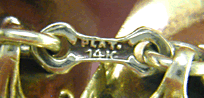
The nickname "Fleur-de-lys maker" derives from the elegant, flowing brackets which help secure this maker's cufflinks on the cuff. The bases of the brackets are reminiscent of an iris in bloom. The Fleur-de-lys maker also utilized a distinctive crossbar marked "PLAT." and "14K" for the precious metals.


Fleur-de-lys maker crossbar.

Next month we will discuss several of the clues that
may be followed to identity an unknown maker.

For more information about these and other fine cufflinks
please visit the Antique Cufflink Gallery.


Cufflinks of the mysterious Fleur-de-lys maker, circa 1925.

Sunday, January 15, 2012

Recent Additions


Recent additions to the Antique Cufflink and the Estate Jewelry Galleries include: striking platinum and black enamel cufflinks from the Jazz Age, intricately engraved white gold cufflinks created by L. Fritschze & Company, a hypnotic pair of diamond-set cufflinks from Wordley, Allsopp & Bliss and an elegant onyx and pearl dress set. A radiant Art Nouveau brooch of Flora, Goddess of Spring, rounds out the new offerings.


Platinum and black enamel cufflinks. (J9103)

Black Tie Striking cufflinks that bespeak the exuberant elegance of the 1920s. Just right for "putting on the Ritz" at Jay Gatsby's next black tie affair. Created in platinum and 14kt gold, circa 1925.


Fritschze intricately engraved Art Deco cufflinks. (J8778)

Intricately Engraved Elegant white gold cufflinks with intricately engraved radiant star bursts or flower heads. The dramatic centers are surrounded by geometric Art Deco borders. Crafted in 14kt gold, circa 1925.


WAB Art Deco cufflinks with diamonds. (J9101)

Mesmerizing Diamonds A hypnotic swirl of concentric circles set with a sparkling diamond. Dramatic black enamel borders complete the design. Created by Wordley, Allsopp & Bliss in 14kt gold, circa 1930.


Later onyx and pearl dress set. (J9095)

Onyx & Pearl Dress Set Dramatic black onyx centers surrounded by elegant white gold borders and set with small white pearls. The dramatic interplay of black and white captures the jazzy elegance of the 1920s. Crafted in 14kt gold, circa 1925.


Art Nouveau Flora brooch. (J9102)

Goddess of Spring A beautifully rendered Art Nouveau brooch of Flora, the Goddess Spring. The Goddess's golden tresses are bestrewn with a bouquet of flowers and foliage. Crafted in 10kt gold, circa 1900.


The above antique cufflinks and fine jewels from the past,
can be found in the Antique Cufflink Gallery
and the Estate Jewelry Gallery


Saturday, December 31, 2011

The Joy of Antique Cufflinks


The Joy of Antique Cufflinks


Carrington engraved MOP dress set, circa 1925.


I hope everyone has enjoyed the best of the Holidays and
is looking forward to an even better New Year!

In earlier notes I have written about the artistry, craftsmanship and history of antique cufflinks. One other factor contributes to the inescapable joy created by cufflinks from the past - the great variety of designs and styles in which they were created.

The years from 1880 to 1950 were a period of ceaseless and dramatic change in jewelry design and the decorative arts in general. Infuences included the historical revivals and countering Aesthetic Movement of the Victorian era, the flowing, otherworldly Art Nouveau and ethereal, sparkling Edwardian jewels of the early 1900s, and the bold, colorful designs of early Art Deco followed by the starker Art Moderne of the 1930s and 1940s. Each of these design movements was reflected in the cufflinks of the day.


Carrington vest button, circa 1925.

In addition to the plethora of design influences, there were numerous cufflink makers each interpreting and playing off the broader design themes in their own unique and imaginative ways. It is estimated that in the United States alone the number of jewelry makers numbered at least several hundred during the early 1900s. No doubt a significant number of these makers created cufflinks at one time of another. It is little wonder that antique cufflinks offer something to suit almost every taste.

For me the great diversity of cufflinks means that, even after working with antique jewelry for several decades, I still enjoy the thrill of coming across beautiful designs I have never seen before. This past year one of my favorite "discoveries" was the wonderful Carrington dress set illustrated through out this note.


Carrington engraved MOP shirt studs, circa 1925.

During the first half of the 20th century Carrington & Company was known for elegantly designed cufflinks and dress sets. The firm's cufflinks often exhibited a formal, if not conservative, simplicity that highlighted the fineness of the precious materials and the beauty of the craftsmanship.

The Carrington dress set highlighted here features mother-of-pearl centers beautifully engraved with a pattern reminiscent of exploding fireworks. Borders of swirling scrolls crafted in white gold bring to mind a starry night sky. And in the centers luminous pearls are is set in a collets with a finely millegrained edge. To me this dress set is the perfect marriage of elegant formality and Jazz Age pizazz.


Carrington and Jazz Age Pizazz, circa 1925.

The celebratory and joyful exuberance of this dress set captures the spirit of the Holiday season and our hopes for the New Year. Fittingly it was acquired during the Christmas season by a couple celebrating an important anniversary.

The above dress set and other fine antique cufflinks
can be found in the Antique Cufflink Gallery.

Thursday, December 15, 2011

Recent Additions


I hope everyone is enjoying the best of the Holiday season and anticipating an even better New Year!

New additions to the Antique Cufflink Gallery and the Estate Jewelry Gallery have slowed as we deal with the annual holiday rush. We have managed to add a pair of striking Art Deco cufflinks by United Jewelers, a Bacchus stickpin from Hans Brassler and a wonderful Victorian swallow brooch.


Jazzy Art Deco cufflinks. (J9100)

Art Deco Pizazz  Jazzy Art Deco cufflinks with bright concentric-circle centers surrounded by a yellow gold band of wave-like scrolls and white gold borders.  Crafted in 14kt gold,  circa 1930.


Brassler Bacchus and Amethyst stickpin. (J9098)

Bacchus  A rich purple amethyst is framed by two images of Bacchus, the God of Wine.  Since the ancient Greeks believed amethyst protected the wearer from intoxication, this is the perfect jewel for a fun loving oenophile.  Crafted in 14kt gold circa 1910.


Riker Bros. swallow brooch. (J9097)

Fly Away!  A wonderful brooch of a swallow in flight.  Among the Victorians swallows were a symbol of a traveler returning safely home.  Created by Riker Bros. in 14kt gold, circa 1900.


Wednesday, November 30, 2011

The Intricate Cufflinks of the Art Deco Era

Frank Krementz Art Deco cufflinks, circa 1925.
The Intricate Cufflinks
of the Art Deco Era

Among collectors of fine timepieces, watches with intricate mechanisms and a plethora of features are known as "complications." The term is also aptly applied to a group of richly detailed cufflinks created during the Art Deco era of the 1920s and 1930s.

Frank Krementz cufflinks, circa 1925.

One school of Art Deco design fervently believed that no visible surface should be left unadorned. The more decoration and embellishment, the better. Applying this design dictum to the small area of a cufflink resulted in mesmerizing cuff jewels.

A master of this style was the cufflink maker Frank Krementz. The firm was adept at combining intricate geometric patterns with stylized floral elements to create striking cufflinks with an incredible, almost obsessive, level of detail. The two cufflinks pictured above are beautiful examples.

L. Fritschze labyrinthine cufflinks, circa 1925.

A contemporary, but less prolific, cufflink maker was L. Fritschze and Company. Based in Newark, New Jersey (as were Krementz and Ziething), the firm specialized in cufflinks with dramatic geometric patterns. One's eye (and imagination) is inescapably drawn into the intricate, labyrinth-like designs. The cufflink pictured above is a striking example.

I have to confess a particular fondness for the Fritschze cufflinks. A fondness that only increases with their relative rarity.

Fritschze marquise and diamond cufflinks, circa 1925.

Art Deco "complications" were usually crafted in white gold or a combination of white over yellow gold. Commercially introduced around 1918, white gold is relatively hard compared to platinum and silver and crisply holds detailed, engraved designs. White gold also tarnishes slightly over time, throwing the intricately engraved patterns into high relief.

Ziething octagonal bull's eye cufflinks, circa 1925.

No discussion of intricate Jazz Age cufflinks would be complete without a few sparkling examples from Ziething & Company. The shimmering, abstract designs adorning Ziething cufflinks were created with a technique reminiscent of bright-cut engraving. As a result, the lively, sparkling designs appear to radiate and dance as they catch the light.

Jazzy Ziething cufflinks, circa 1925.

Some of Ziething & Company's finest work are striking two-tone cufflinks. In these the brightness of richly engraved white gold borders contrasts with the warmth of equally intricate yellow gold centers. Pictured above are two beautiful examples.

A final example of the intricate cufflinks of the Art Deco era. Crafted in white gold these cufflinks feature dramatic floral and cruciform centers above a field of concentric circles. The canted-corners are embellished with acanthus leaves (or possibly flaming scrolls) with elongated Greek key designs along the edges in between. One side is set with a small diamond. An awful lot of decoration for a very small piece of real estate!

These and other fine antique cufflinks can be found in the Antique Cufflink Gallery.

Tuesday, November 22, 2011

New Additions to Antique Cufflink Gallery


Kohn & Company Art Deco cufflinks, circa 1930.

For timely updates when new pairs of cufflinks are added to the Antique Cufflink Gallery, please visit our new Facebook and/or Twitter pages. Photographs and links will be posted as new cufflinks are added.

Similar photographs and links will also be posted for new additions to the Antique and Estate Jewelry Gallery.

I hope everyone enjoys a festive and peaceful Thanksgiving!

Art Anderson