Showing posts with label platinum cufflinks. Show all posts

Saturday, May 31, 2014

Carrington Cufflinks and the Mysterious Mr. Goldsplat


Carrington onyx and diamond cufflink, circa 1920.

Founded in 1900, Carrington & Co. created elegant gold and platinum cufflinks during the first half of the 20th century. In addition to fine cufflinks, the firm was renowned for elegant dress sets, vanity cases, lockets and other jewels. Carrington cufflinks and accessories were retailed by the finest jewelers of the day including Tiffany & Co. and Cartier.


Reverse of Carrington onyx and diamond cufflinks.

Although the fronts of antique cufflinks are what first attract us, a careful examination of the backs is rewarding in its own way. The backs often provide clues as to the maker and age of the cufflinks, as well as the quality of the craftsmanship and the purity of the materials. This note focusses on the maker's marks and precious metal indicia found on the cufflinks of Carrington & Co.


Maker's mark.

The Carrington maker’s mark was a squared, angular “C” surrounding "14" or "18" which indicates the purity of the gold. The maker's mark is most often found on the reverse of the cufflinks, although occasionally it is stamped on the side of the cross bar.

Although most Carrington cufflinks were created in 14kt gold, every so often you come across a pair that is crafted in 18kt gold. The 18kt pairs may have been special commissions created at the request of a client or retailer.


Shirt stud with "C14" mark.

In dress sets, the vest buttons were signed like the cufflinks with a squared "C" enclosing a gold purity mark. Shirts studs, because of their small size, were simply signed with a diminutive "C14" or "C18" along the shank.


Carrington platinum and gold cufflink, circa 1925.

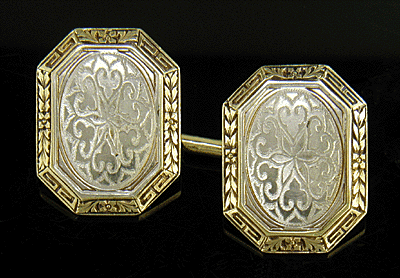
Carrington worked with platinum as well as gold. The firm created beautiful mixed-metal cufflinks with striking platinum borders and richly engraved platinum tops over solid gold backs. The above example features platinum borders with etched mother-of-pearl centers. The backs and linkage are crafted in 14kt yellow gold.

In addition to the Carrington maker's mark, the gold and platinum cufflinks are stamped with "GOLD&PLAT." on the reverse. This mixed-metal mark is fairly small and at times can be obscured by wear. This occasionally leads to some confusion.


Carrington mixed-metal mark.

Every so often I receive an inquiry about a pair of cufflinks signed by a mysterious jewelry maker named "GOLDSPLAT". At other times I am asked about cufflinks signed with a "C" and "14" and marked "GOLD PLATED". Needless to say, the Goldsplat signature is a misreading of the gold and platinum mark and, to the best of my knowledge, Carrington & Co. never created gold plated cufflinks.


Carrington platinum cufflinks, circa 1920.

Last, but not least, are the all platinum cufflinks. One of the more desired rarities in the world of antique cufflinks are the beautifully engraved platinum cuff jewels created by Carrington & Co. in limited numbers during the 1920s. The above photograph illustrates a mesmerizing example.


Carrington platinum mark.

The Carrington solid platinum cufflinks are simply marked "PLATINUM". There are no squared "C"s or other marks indicating that the cufflinks were created by Carrington & Co. The cufflinks are attributed to Carrington based on the quality of the craftsmanship, the pattern of the engraving, and the design of the brackets and linkage. Like the 18kt gold cufflinks, the solid platinum cufflinks may have only been created as special commissions when requested by a client or retailer.


Carrington cufflinks in the Retro style, circa 1950.


For half a century Carrington & Co. created fine cufflinks and dress sets. During most of this period the Carrington maker's mark and precious metal marks remained unchanged. However, in the years following World War II the marks were modified. In this period, Carrington was creating cufflinks in a heavier, bolder style that in recent years has come to be known as "Retro". These glittering examples of mid-century modernism were signed with the amended mark.


Maker's Mark, circa 1950.

The new mark features an elongated, less boxy "C" with "14K" appended to the right. What prompted this change, perhaps to make the gold purity more explicit or to comply with a regulatory change, is unknown. The new mark appears to have been limited to cufflinks crafted in 14kt. I have not come across a pair of 18kt gold cufflinks similarly marked. The new mark appears to have been used from the mid 1940s until the firm's closure around 1950.


Keller maker's mark.

The later Carrington mark is sometimes confused with the similar mark of another early 20th century cufflink maker, Charles Keller & Company. Charles Keller & Co. was a prolific maker of gold and platinum cufflinks from 1885 to about 1930. The Keller maker's mark, shown above, is a rounded "C" enclosing the gold purity followed by a "K". Here the "K" does double duty as the initial for both karat and Keller. At times Keller cufflinks have been misidentified as the work of Carrington. Because Keller cufflinks can be less valuable, it pays to know your marks.


Fine cufflinks from Carrington & Co. and other notable makers
can be found in the Antique Cufflink Gallery.

Sunday, January 15, 2012

Recent Additions


Recent additions to the Antique Cufflink and the Estate Jewelry Galleries include: striking platinum and black enamel cufflinks from the Jazz Age, intricately engraved white gold cufflinks created by L. Fritschze & Company, a hypnotic pair of diamond-set cufflinks from Wordley, Allsopp & Bliss and an elegant onyx and pearl dress set. A radiant Art Nouveau brooch of Flora, Goddess of Spring, rounds out the new offerings.


Platinum and black enamel cufflinks. (J9103)

Black Tie Striking cufflinks that bespeak the exuberant elegance of the 1920s. Just right for "putting on the Ritz" at Jay Gatsby's next black tie affair. Created in platinum and 14kt gold, circa 1925.


Fritschze intricately engraved Art Deco cufflinks. (J8778)

Intricately Engraved Elegant white gold cufflinks with intricately engraved radiant star bursts or flower heads. The dramatic centers are surrounded by geometric Art Deco borders. Crafted in 14kt gold, circa 1925.


WAB Art Deco cufflinks with diamonds. (J9101)

Mesmerizing Diamonds A hypnotic swirl of concentric circles set with a sparkling diamond. Dramatic black enamel borders complete the design. Created by Wordley, Allsopp & Bliss in 14kt gold, circa 1930.


Later onyx and pearl dress set. (J9095)

Onyx & Pearl Dress Set Dramatic black onyx centers surrounded by elegant white gold borders and set with small white pearls. The dramatic interplay of black and white captures the jazzy elegance of the 1920s. Crafted in 14kt gold, circa 1925.


Art Nouveau Flora brooch. (J9102)

Goddess of Spring A beautifully rendered Art Nouveau brooch of Flora, the Goddess Spring. The Goddess's golden tresses are bestrewn with a bouquet of flowers and foliage. Crafted in 10kt gold, circa 1900.


The above antique cufflinks and fine jewels from the past,
can be found in the Antique Cufflink Gallery
and the Estate Jewelry Gallery


Friday, July 31, 2009

Curvaceous Cufflinks

Sapphire and entwined heart cufflinks, circa 1900.

In the years around 1900 cufflinks and jewelry took a new turn. In fact, cufflink designs took a great many turns as fin de siecle jewelers and jewelry lovers embraced sinuous, intertwining curves. The dramatic whiplash curves of Art Nouveau designs, the intricate interwoven curves of ancient Celtic art, and sinuous serpents and flowering vines can all be found embellishing cufflinks of the period. A few of these curvaceous cufflinks are illustrated below.


Late Victorian serpent and vine cufflinks.

Sinuous entwined snakes and clematis vines decorate these late Victorian cufflinks. The Victorians loved jewels with hidden message and secret meanings. Intertwined or coiled snakes were considered a symbol of good fortune and eternal love. Clematis was a symbol for ingenuity. Perhaps the secret message of these cufflinks is that a long relationship or marriage takes both luck and ingenuity. Crafted in 14kt gold by Krementz & Company, circa 1890.


Celtic Revival cufflinks crafted in 14kt gold.

In addition to nature - snakes and vines - Victorian jewelers also drew inspiration from ancient civilizations and past cultures. Often sparked by archaeological discoveries, the Victorians enjoyed a seemingly endless parade of Egyptian, Classic, Etruscan, Roman, Viking, Celtic, Gothic, Medieval and Renaissance Revivals.

In the 1890s Archibald Knox working with Liberty & Company drew upon the intricate curvilinear designs of ancient Ireland. Knox's work inspired other designers and blossomed into the Celtic Revival. Beautiful jewels and objects were inspired by the interlaced motifs of the ancient Celts. The cufflinks illustrated above are a wonderful example. Crafted in 14kt gold by George Street & Sons, circa 1900.


Krementz & C0. Art Nouveau cufflinks.

Art Nouveau design could be described as curves unbound. While Art Nouveau jewelers also found inspiration in the sinuous forms of nature, they added imagination and fantasy to create never-before-seen jewels. The bold, exotic curves of Art Nouveau jewels are less restrained and more free flowing than in jewels of the late Victorian period.

The above cufflinks, created by Krementz & Co. around 1900, illustrate the new taste for dramatic curves and asymmetric design. Krementz was one of the leaders in introducing Art Nouveau design to the United States. You can find more about Krementz and the Art Nouveau in my earlier post Art Nouveau Cufflinks


To view these and other cufflinks from the past,
please visit our Antique Cufflinks Gallery.


Saturday, February 28, 2009

Platinum and Gold Cufflinks

Carrington Platinum and Pearl Dress Set, circa 1925.

Platinum is a magical metal. It beautifully holds intricate engravings, can be polished to a mirror-like finish and attains a shimmering, frosty patina over time. And, because of its purity, platinum does not tarnish like white gold and silver.

When first encountered by Europeans in the 1500s, platinum was discarded as "unripened silver." Platinum melts at a much higher temperature than gold or silver. As a result, it was a difficult metal for jewelers and creators of objet d'art to work with. During the Victorian era technological advances, like the high-heat oxyhydrogen blow pipe, made working with platinum more feasible. By the early 1900s the brilliance of platinum had captivated the jewelry world. The brilliant white metal became almost de rigueur for fashionable cufflinks and other fine jewels. In my opinion some of the finest platinum cufflinks were created during the early 1900s, culminating with the Jazz Age of the 1920s. The Carrington pearl and platinum cufflinks pictured above nicely capture the elegance and style of the age.


Frosty platinum and gold cufflinks, circa 1920.

One of the appealing qualities of platinum is the rich patina it takes on over time. In winter we occasionally get a snow shower mixed with fine particles of ice. At night, especially under a full moon, the freshly fallen snow and ice crystals shimmer and sparkle with a magical glow.

Antique platinum often has a similar appearance. Platinum does not tarnish, but over the years platinum cufflinks can accumulate microscopic scratches and abrasions that give the metal a shimmering, magical glow. The effect is sometimes called "Platinum Frost". The frosty platinum cufflinks pictured above are a striking example.


Beautifully engraved platinum and gold cufflinks, circa 1920.

The increasing demand for and limited supply of platinum resulted by the early 1920s in platinum costing eight to ten times as much as gold. Although occasionally you will come across a beautiful pair of solid platinum cufflinks from the early 1900s, most often platinum was combined with gold to create richly engraved cufflinks with platinum tops and gold backs. The pair pictured above feature geometric Art Deco borders which perfectly complement the richly engraved centers. I suspect many platinum cufflinks were patriotically sacrificed during World War I and II when the precious metal was needed for strategic purposes.


Carter, Gough platinum and gold cufflinks, circa 1920.

A beautiful variation on the platinum and gold theme are elegant two-tone cufflinks. Striking two-tone cufflinks from the 1920s add elegant pizzazz to any cuff. The Carter, Gough cufflinks pictured above feature platinum borders embellished with "C" scrolls and intricately engraved yellow gold centers. Carter, Gough and its predecessor firms created beautiful gold and platinum cufflinks and jewels from the mid 1800s to the early 1930s.

Below is a slightly earlier pair of platinum and gold cufflinks from Durand & Company, another maker of exceptional cufflinks during the Victorian and Edwardian eras. As a bit of cufflink trivia, the founders of Durand & Company, were cousins of the Hudson River school painter Asher B. Durand. I have always wondered if the artistic pursuits of the jewelers and painter ever influenced each other.


Durand & Co. platinum and gold cufflinks, circa 1910.


For additional views of the cufflinks pictured above,
please click the pictures.

To view these and other fine cufflinks from the past,
please visit our Antique Cufflink Gallery.


Saturday, April 19, 2008

Charles Keller's Frosty Cufflinks


Featured this week are several of the frosty cufflinks created by Charles Keller & Co. during the early 1900s. Above is a nice example with the radiating spiral motif popular during the Art Deco period. These cufflinks are crafted with platinum tops and 14kt gold backs. The platinum tops are beautifully engine-turned with swirling radiant spirals. The radiant centers are accented with black enamel and surrounded by flowing leaf-and-vine borders. Crafted in 14kt gold and platinum, circa 1920.


The cufflinks were created by Charles Keller & Company. Founded in 1885, Charles Keller manufactured gold and platinum cufflinks, lockets and other jewels in workshops based in Newark, New Jersey. During the early decades of the last century, the firm specialized in creating elegant cufflinks with intricately engraved platinum or white gold surfaces. Charles Keller remained in business until the early 1930s.


The cross bars are stamped with the precious metal mark for platinum, "PLAT". To the right of the platinum mark is the maker's mark of Charles Keller & Company, an elongated "C" followed by the letter "K". In side the "C" is a karat mark, "14", for the purity of the gold.


Every so often the Charles Keller mark is misidentified as the mark of another fine cufflink maker, Carrington & Company. The Carrington mark also has a "14" surrounded by a "C" . However, in the Carrington mark the "C" is squarish and angular, not elongated and rounded like the Keller mark. As always, care should be taken when reading and interpreting makers' marks.


Here is a second pair of beautifully engraved Charles Keller cufflinks. The platinum tops are engine turned with a stippled pattern of concentric circles. This gives the cufflinks a frosty, shimmering appearance. The stylized flower (or star) motifs were created by leaving areas of the brightly polished platinum unstippled. The border is a classic egg-and-dart pattern recalling the Beaux-Arts style of the late 1800s. Crafted in platinum and 14kt gold, circa 1920.


Saturday, April 12, 2008

Cufflinks ... Chicago Style?

Gold and Platinum Cufflinks by the "L-maker."

Every so often you will come across an elegant pair of gold and platinum cufflinks marked on the reverse with a small script "L". The cufflinks are usually rectangular in shape with beveled corners, much like an emerald-cut diamond. The tops are embellished with intricately engine-turned centers surrounded by foliate and geometric borders. I have nicknamed the unknown maker of these cufflinks the "L-maker". Here are a few examples.


Beautifully engine-turned 14kt yellow gold cufflinks with intricate acanthus leaf borders. These cufflinks are a nice example of the rich gold work characteristic of gentleman's jewelry in the early decades of the last century. Crafted by the "L-maker", circa 1920.


This pair beautifully displays the cool geometry of Art Deco design. Engraved and dimpled trapezoid borders surround chequered platinum centers. Crafted by the "L-maker" in 14kt gold and platinum, circa 1930.

The reverse of these cufflinks are stamped with precious metal marks and the maker's mark - a small script "L" in a lozenge (diamond shape). Hence the name "L-maker."


The mark is similar to the maker's mark of Lebolt & Co., a retail jeweler founded in Chicago in 1899. Inspired by the fashion for hand crafted silver in the early 1900s, Myer Lebolt, founder of the firm, opened a workshop to create custom silver pieces for his retail stores in Chicago and New York. Eventually the workshop included goldsmiths and platinumsmiths who created jewelry in addition to the firm's sterling flatware and holloware. It is possible these elegant cufflinks were created in the Lebolt workshop during the 1920s.

At this time, an attribution of these cufflinks to Lebolt & Co. is only a working hypothesis. The similarity of the marks is suggestive, but not conclusive. It is wise to confirm the identification of an unknown maker's mark with other sources such as old catalogs, original sales receipts and period advertisements. Family recollections and company names on jewelry boxes can also be helpful, but are sometimes less reliable. The mystery of the "L-maker" may be closer to a solution, but further research remains to be done.

If you would like to read more about Lebolt & Co. and the Chicago silversmiths, there is a wonderful book, Chicago Metalsmiths, by Sharon Darling. Although the book is out of print, it is worth a trip to the library or a secondhand book shop to find a copy.


Sunday, March 23, 2008

Platinum and Gold Cufflinks

Carter, Gough & Co. Platinum and Gold Cufflinks
Crafted in platinum and 14kt gold, circa 1920

Fine antique cufflinks have been made in a variety of materials ranging from precious metals to tortoise shell, pearl, ivory, Vulcanite (an early form of hardened rubber), Bakelite and glass. In fact just about any material that imaginative jewelry makers could shape, bend or mold can be found in a pair of cufflinks. Among the precious metals, platinum, gold and silver have been the most popular with palladium, a platinum group metal, making a rare appearance.

Prior to 1900, platinum's high melting point limited the metal's use in fine jewelry and cufflinks. With the development of high-heat torches the limited use of platinum began to melt away. Some of the most striking cufflinks from the early decades of the 20th century elegantly contrast gold and platinum. These two-tone cufflinks sparkle with the warmth of antique gold and cool brilliance of platinum. Here are a few examples.


An exquisite pair of platinum and gold cufflinks from Carter, Gough & Co. During the early decades of the last century, the firm created beautiful cufflinks and dress sets in the sparkling, airy style of the Edwardian period. Carter,Gough cufflinks appear to dance in the light as you move your cuffs. For another example, please revisit the photograph at the top of this post.


Elegant two-tone cufflinks in the bold Art Deco style. These cufflinks feature checker board platinum centers surrounded by engraved and dimpled gold borders. Crafted around 1930, I believe these cufflinks were created by the Chicago jewelers Lebolt & Co. There is something undeniably magical about the cool geometry of Art Deco design.


For more elegant cufflinks crafted in platinum and gold,
please visit our Antique Cufflink Gallery.


Saturday, March 15, 2008

Carrington Cufflinks - A Touch of Elegance


Carrington & Company Platinum Cufflinks
Crafted in platinum, circa 1920

Carrington & Company was one of the premier makers of cufflinks in America during the first half of the last century. Founded in 1900 the firm was renowned for creating elegant jewels and accessories for men and women. The firm was based in Newark, New Jersey and produced jewels and cufflinks for the finest jewelers and luxury retailers of the day, including Tiffany & Company. After surviving changing fashions, the Great Depression and two World Wars the firm discontinued operations in 1950.

I must admit to being an unabashed admirer of Carrington cufflinks and dress sets. Working in gold and platinum, the firm excelled at creating simple, balanced designs that were bold without being ostentatious. The cliche "understated elegance" is appropriately applied to Carrington cufflinks. Here are a few of my favorites.


There is something undeniably elegant about brilliant platinum, sparkling diamonds and black Onyx. These Carrington cufflinks feature eight-sided Onyx tops with diamond centers and ornately engraved platinum borders. Truly "Putting on the Ritz!" Crafted in platinum and 14kt gold, circa 1920.


Wonderful Art Deco cufflinks featuring Mother of Pearl centers surrounded by bright-cut platinum borders. The Mother of Pearl centers are beautifully engraved with fine wavy lines. Crafted in platinum and 14kt gold, circa 1930.


Bold Carrington cufflinks with alternating stripes of engraved gold and green enamel. These elegant cufflinks epitomize the classic geometry and primary colors of the Art Deco era. The pair was retailed by Tiffany & Company and is shown with its original box. Crafted in 14kt gold, circa 1935.


Gold Carrington cufflinks that are a nice example of the bolder, more robust Art Deco designs of the late 1930s and 1940s. The dramatic horizontal and vertical stripes are reminiscent of the Abstract Expressionist art of the 1950s. Crafted in 14kt gold, circa 1945.


For more Carrington and beautiful cufflinks by other makers,
please visit our Antique Cufflink Gallery.


Thursday, February 7, 2008

Carrington Platinum Cufflinks


Another pair of striking solid platinum cufflinks from the 1920s. This pair features linearly engraved centers surrounded by scrolling wave-like borders. On the back they are engraved "12-25-23". Somebody had a very good Christmas in 1923!

Like the pair I featured earlier, these platinum cufflinks were created by Carrington & Company. Carrington was a maker of fine cufflinks and other jewels during the first half of the last century, 1900 to 1950. They made beautiful gold and platinum cufflinks for many of the finest retailers of the day, like Tiffany & Company.

Solid platinum cufflinks from the early 1900s are rare. In the early 1920s platinum cost eight to ten times as much as gold. So platinum cufflinks were often made with only a thin layer of engraved platinum on top of 14kt yellow gold.


Monday, February 4, 2008

Antique Platinum Cufflinks


Carrington platinum swirl cufflinks. (J8475)


Beautifully crafted platinum cufflinks that epitomize the cool elegance of the 1920s. This pair features intricately engine-turned radiant centers surrounded by wave-like borders. Crafted by Carrington & Company, circa 1920.

Antique platinum cufflinks are relatively rare. Because of the scarcity and costliness of platinum, few platinum pairs were created. Then, during World War II platinum jewels were often sacrificed to support the war effort. Recent record prices for platinum and gold have undoubtedly resulted in a further loss of fine antique jewels. The survival of an exceptional pair of platinum cufflinks is a rare event.