Showing posts with label Fleur-de-lys maker. Show all posts

Friday, May 4, 2012

Recent Discovery in the Antique Cufflink Archive


While researching a unrelated topic in the Antique Cufflink Archive, I came across several additional examples of cufflinks created by the Fleur-de-lys Maker.


The cufflinks are elegant elongated octagons, essentially rectangles with deeply cut corners. While the shape doesn't have the same jagged edginess as the examples illustrated in last week's post, the cufflinks exhibit the same care in craftsmanship, design and fine detail.


Hopefully more examples of the Fleur-de-lys Maker's work will emerge in the coming weeks.

These and a great variety of other cufflinks from the past
can be found in the Antique Cufflink Archive

Monday, April 30, 2012

Clues to the Identity of the Fleur-de-lys Maker


The "Fleur-de-lys" Cufflink Maker
Clues to the Identity

Cufflinks of the Fleur-de-lys Maker, circa 1925.

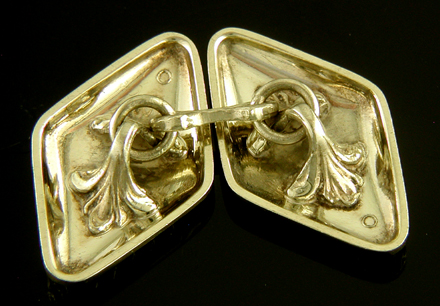
Recently we have been discussing cufflinks created by an unknown maker nicknamed the "Fleur-de-lys Maker". The moniker refers to the distinctive brackets the jeweler used to anchor the cross bars on the reverse of the cufflinks.

In this final post (at least for now) on the Fleur-de-lys Maker I would like to review some of the clues we have to the maker's identity.  Although we have not identified the Fleur-de-lys Maker, these clues offer directions for further research.  Here is what we currently know about this mysterious maker.


Cufflinks of the Fleur-de-lys Maker, circa 1925.

A small body of striking cufflinks is attributed to the Fleur-de-lys Maker. The cufflinks feature richly detailed centers and dramatic borders. They are crafted in platinum and 14kt gold and date from the decades around 1925.

In addition to fleur-de-lys brackets, the cufflinks have distinctive outlines with jutting angles and unsmooth edges. The designs go against the prevailing fashion dicta that cufflinks should have rounded profiles, or at least softened corners, to ease their passage through a buttonhole. The cufflinks of the Fleur-de-lys Maker have a dramatic edginess.


Brackets of the  Fleur-de-lys Maker cufflinks.

The flowing fleur-de-lys brackets have an Art Nouveau feel, while the decorative designs and borders date the cufflinks to the 1920s or early 1930s. A notable cufflink maker during this period  was Charles Keller & Company, a prolific maker of fine cufflinks and other jewels from the 1880s to about 1930.  The firm created a great variety of cufflinks employing a number of linkage and bracket designs. Among them were fleur-de-lys inspired brackets.


Charles Keller  fleur-de-lys brackets.

This raises the possibility that Charles Keller is our mystery maker.  But several factors urge caution.  The Charles  Keller fleur-de-lys brackets are stylized and flattened with more of an Art Deco, than an Art Nouveau, feel. Further, although Charles Keller created many beautiful cufflinks, I have yet to encounter an example of the firm's work which matches the exuberant design and careful craftsmanship of our mystery maker.  Charles Keller & Company remains a possibility, but the link, if any, needs to be further explored.


Possible maker's mark.

A second possible clue to the identity of the Fleur-de-lys Maker is found on the reverse of the marquise-shape cufflinks pictured at the top of this post.  Just outside of the foot of one of the brackets is an indistinctly struck a "C" or "G" inside a diamond-shape cartouche.  The mark is found on only one reverse and appears to be more accidental, than deliberate.

The Providence-based jewelry manufacture S. B. Champlin Company employed a similar mark in the early 1900s.  Established in 1872 by Stanton B. Champlin, the firm created cufflinks and other jewels until 1931.  But any connection between our mystery maker and S.B. Champlin is for now at best tenuous.  The mark appears on only one cufflink, is indistinct (it may be a "G" instead of "C"), and may have been inadvertent.  Other signed examples of the maker's work will need to be found before drawing any conclusions.


Fleur-de-lys Maker cufflinks with black enamel accents, circa 1925.

To recap, we have several directions for future possible research, but still no answer to the question "Who was the Fleur-de-lys Maker?"  I would love to hear from any readers who have similar cufflinks or possible knowledge of the maker.  I will be happy to post any new clues that are uncovered and eventually we will solve this riddle.


For more information about these and other fine cufflinks
please visit the Antique Cufflink Gallery.


Wednesday, February 29, 2012

Investigating Mystery Cufflink Makers


Investigating Mystery Cufflink Makers

Fleur-de-lys bracket maker cufflinks, circa 1925.

Last month I illustrated several pairs of beautiful cufflinks created by an unidentified maker who has been nicknamed the "Fleur-de-lys maker". The cufflinks are characterized by intricately engraved (engine turned) platinum or gold centers, bold borders and dramatic shapes. The moniker refers to the dramatic, flowing brackets the maker used to anchor the cross bars on the reverse of the cufflinks.


Fleur-de-lys maker cufflinks, circa 1925.

Identifying the maker of an unsigned pair of cufflinks can be a daunting task. Fortunately there are several directions in which to look for clues.


1. The first place to look is among signed cufflinks with similar decorative elements and motifs. Cufflinks with similar borders and central motifs may help identify the unknown maker, but caution should be exercised. Popular designs motifs were often embraced by more than one maker. It is not uncommon to come across cufflinks with very similar borders and/or central designs that were created by two different makers.

2. The construction details and linkages of cufflinks can also provide clues. A hundred years ago cufflink makers took great care in designing both the decorative and working parts of their cufflinks. The emphasis was on creating beautiful, sturdy cufflinks that would pass the test of time. An earlier note on the cufflinks of Durand & Company illustrates the care taken in all aspects of cufflink design.

Distinctive linkages, brackets and other working details may suggest the maker of an unsigned pair of cufflinks. But, here again, caution is advised. Bracket, crossbar and bridge designs may have been copied or used by more than one maker or may have been produced by a third manufacturer and sold as "findings" - parts to be used in the assembly of jewelry. The construction details of a cufflink may be a helpful clue in identifying the maker, but it may not be definitive.

3. Browsing through old jewelry catalogs and trade advertising is one of the pleasures of researching antique cufflinks. In addition to the inescapable charm of these period documents, you get a sense of how cufflinks were perceived, or at least presented, in the day.

For purposes of identifying cufflinks the catalogs of jewelry manufacturers are the most helpful. The catalogs of jewelry retailers, while of interest in themsleves, rarely identified the makers of the cufflinks and other jewels offered. Unfortunately period catalogs and ads only document a small sampling of the the great variety of cufflinks that were created. It is rare that you will find an illustration of the specific cufflink you are researching.

4. Finally, patent filings for cufflinks are also a helpful source of information. Early patent filings included beautiful hand-drawn illustrations of the cufflinks from several angles and with the smallest details shown. In addition to the drawings, the patent filings included detailed descriptions that provide insight into the inventor's thought process and goals in creating the design. The earlier mentioned note on Durand & Company provides a wonderful example.


Although none of these approaches alone may be definitive in attributing an unsigned pair of cufflinks, together they may suggest the maker or at the very least further avenues of research. Next month we will discuss several clues that may help us identify the Fleur-de-lys maker. Meanwhile I would love to hear from any readers with examples or knowledge of this maker's work.


Fleur-de-lys maker cufflinks with black enamel accents, circa 1925.

For more information about these and other fine cufflinks
please visit the Antique Cufflink Gallery.

Tuesday, January 31, 2012

Cufflinks of the Mysterious "Fleur-de-lys" Maker


Cufflinks of the Mysterious
"Fleur-de-lys" Maker

Cufflinks of the mysterious "Fleur-de-lys" maker, circa 1925.

The Stamping Act of 1906 required that makers of gold and silver jewels in the United States mark their pieces with the purity of the precious metals. But it was not until 1961 that American jewelry manufacturers were required to sign their pieces with a maker's mark. As a result, there is a body of fine cufflinks created in the first half of the 20th century that are unattributed. The anonymous makers of these beautiful cufflinks have been nicknamed the "Mystery Makers."

Frequent readers of this blog are aware of my interest in the Mystery Makers. This month I feature several striking cufflinks from an unidentified cufflink maker who favored distinctive Fleur-de-lys brackets. The aptly named "Fleur-de-Lys" maker created richly engraved platinum and gold cufflinks in the years around 1925. At the top of this note is a wonderful example with intricately engraved platinum centers flanked by black enamel accents and surrounded by bold zigzag borders.


Fleur-de-lys maker cufflinks, circa 1925.

The Fleur-de-lys maker united jazzy, dramatic borders with intricately engraved centers in a pleasing fusion of Edwardian and Art Deco design. The bold borders beautifully balance the engraved designs and are an integral part of the overall design. All to often borders appear to have been added to cufflinks as an afterthought merely to relieve the plainness of an unfinished edge.

The above Fleur-de-lys maker cufflinks have jazzy Art Deco borders and radiant engraved star burst centers that capture the excitement of the era. They would have been the perfect accessory for an elegant affair at Jay Gatsby's.


Fleur-de-lys Bracket maker cufflinks, circa 1925.

In addition to dramatic borders and intricately engraved centers, the Fleur-de-lys maker favored unusual shapes. Traditionally cufflink makers favored soft, rounded shapes so a cuff could be easily dressed. The design dicta was to avoid obtruding edges and sharp corners that might catch while a cufflinks was being passed through a buttonhole. The most common cufflink profiles were circles, ovals and rectangles with the corners rounded or cut away.

In contrast the Fleur-de-lys maker favored marquises, navettes and hydrid shapes with right angles and unsoftened corners. The unique cufflinks have elegantly jagged profiles that speak to the Art Deco fascination with technology, an embracing of the Machine Age. Given the striking beauty of the cufflinks, any difficulty slipping one through a recalcitrant buttonhole is well worth the effort.


Reverse of Fleur-de-lys maker cufflinks.

Several of the Mystery Makers are known by the distinctive linkages - brackets, bridges and cross bars - they employed. In earlier posts I have written about the Winged Bridge and Acanthus Bridge makers.

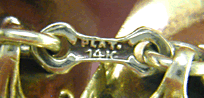
The nickname "Fleur-de-lys maker" derives from the elegant, flowing brackets which help secure this maker's cufflinks on the cuff. The bases of the brackets are reminiscent of an iris in bloom. The Fleur-de-lys maker also utilized a distinctive crossbar marked "PLAT." and "14K" for the precious metals.


Fleur-de-lys maker crossbar.

Next month we will discuss several of the clues that
may be followed to identity an unknown maker.

For more information about these and other fine cufflinks
please visit the Antique Cufflink Gallery.


Cufflinks of the mysterious Fleur-de-lys maker, circa 1925.