Showing posts with label Enos Richardson. Show all posts

Tuesday, October 23, 2018

The Back Story - Radiant Jazz Cufflinks


http://www.jewelryexpert.com/catalog/Richardson-Radiant-Wave-Cufflinks-J9286.htm
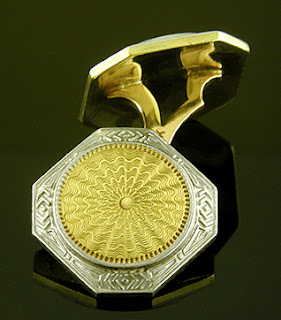
Radiant Jazz Art Deco cufflink.

The imagination and creativity of the cufflink makers of the late 19th and early 20th century is undoubted.  A quick scan of the Antique Cufflink Gallery is all that is needed to confirm.  What may be lesser known is that the same level of inventiveness and artistry is often evident in the linkages devised to hold the fronts and backs of the cufflinks together.

A hundred years ago cufflinks makers wrestled with two challenges:  to create cufflinks that could be easily put on a cuff and that would also remain safely in place when worn.  The inventive spirit of the age was brought to bear on this issue and a great variety of linkage designs and mechanisms was created.  The striking Art Deco cufflink pictured offers an interesting example of linkage design.  It was created around 1925 by the Richardson Manufacturing Co.


Art Deco cufflink, circa 1925
Reverse of Art Deco cufflink.

The linkage features a dramatically cut-out bridge that is hinged at one end and rigidly attached at the other. The hinged end allows the top of the cufflink to lie flush against the bridge as it passes through a button hole and the rigid end serves as a "push plate" allowing the wearer's thumb to help ease the cufflink through the cuff. As more angular, sometimes geometrically complex cufflinks came into fashion during the Art Deco era a little encouragement of the cufflink through the cuff was sometimes needed.

Once the front of the cufflink passed through the button hole, the top opened and lay flat against the cuff securely anchoring the cufflink in place. The design is both functional and aesthetically pleasing. The same careful thought that was applied to the design and crafting of the finely decorated tops was also applied to the linkages.


More examples of fine antique cufflinks can be found


Friday, May 15, 2015

Recent Additions - Cufflinks and Stickpins


Recent additions to the Antique Cufflink Gallery include Krementz Lions with amethysts, Art Deco Sapphire and Diamond cufflinks and elegant Carrington Onyx and Platinum cufflinks.


Krementz roaring lion with amethyst cufflinks. (J9290)

Lions and Amethysts  A roaring lion grasps a deep purple amethyst in his mouth as he announces his authority over the windblown grasses of the savanna.  Crafted in 14kt gold, circa 1900.    Cost:  Sold


Elegant sapphire and diamond cufflinks. (J9289)

Sapphires and Diamonds  Bright blue sapphires and sparkling diamonds set amid finely engraved, intertwining foliage.  Elegant scroll-and-volute borders in the early Art Deco taste decorate the edges.  Crafted in 14kt gold,  circa 1925.    Cost:  Sold


Hexagonal gold cufflinks with black enamel tracery. (J9282)

Black and Gold  Dramatic cufflinks with intricate scroll and geometric designs highlighted with black enamel accents.  The interplay of the rich designs, hexagonal shape and black enamel tracery give these cufflinks a regal, jazzy elegance.  Crafted in 10kt gold,  circa 1920.    Cost:  $575


Art Deco zigzag cufflinks. (J9286)

Radiant Zigzags  Finely engraved zigzags radiate in cascading waves toward white gold borders embellished with geometric and stylized floral motifs.  The shimmering centers and bold borders contrast with perfect Art Deco elegance.  Crafted in 14kt gold,  circa 1925.    Cost:  $1,125


Huger Art Deco sapphire cufflinks. (J9278)

Sapphire Jazz  Bright blue sapphires sparkle amid a cascade of finely engraved lines.  The mesmerizing centers are surrounded by borders of alternating scroll and floral (or dragonfly) motifs.  Crafted in 14kt gold, circa 1925.   Cost:  $925


Carrington onyx and platinum cufflinks. (J9287)

Carrington Onyx  The elegant contrast of brilliant, white platinum with the dark reflections of polished onyx.   Finely engraved zigzags on the platinum borders add a final touch of elegance.  Crafted in platinum and 14kt gold,  circa 1925.    Cost:  $885


Recent additions to the Antique Stickpin Gallery feature a Winged Lion and pearl stickpin and a Hans Brassler radiant triangle stickpin.


Winged lion and pearl stickpin. (J9291)

Winged Lion  A fantastic creature with the head of a lion, wings of an eagle and sinuous body of a serpent.  A striking example of the Victorian fascination with mythological creatures.  Crafted in 14kt gold,  circa 1890.   Cost:  $375


Hans Brassler pearl stickpin. (J9285)

Pearl Triangle  A rounded triangle set with a luminous pearl.  Golden bridges rise from the corners to cradle the pearl at their apex.  Created by Hans Brassler in 14kt gold, circa 1910.    Cost:  $475


These and other fine jewels from the past can be found in
the Antique and Estate Jewelry Galleries


Wednesday, July 31, 2013

Jazz in White and Gold


Jazzy two-tone cufflinks, circa 1930.


In 1920, David Belais of Belais Bros., a jewelry manufacturer based in New York, received a patent for a gold alloy that was a frosty white. He hoped that the new white metal would be a remedy to the high cost and scarcity of platinum caused in part by shortages during the first World War.

Although Belais did not invent white gold (Tiffany & Company had used white gold in a limited way as early as the 1880s), the firm's successful introduction and promotion of the new precious metal led to a blizzard of frosty jewels during the 1920s and 1930s. Among the best of these were jazzy Art Deco cufflinks wedding white and yellow gold.


Elegant pinstripe cufflinks, circa 1930.


The white and yellow gold cufflinks ran the gamut of Art Deco design from the intricate, busy "complications" of the early 1920s to the simpler, geometric designs of the late 1920s and 1930s. This elegant pair of pinstripe cufflinks illustrates the stark, linear designs of the later Art Deco period. The white gold bands are polished to a mirror-like finish which contrasts nicely with the warmer tones of the yellow gold pinstripes and borders. Created my Richardson Manufacturing Company in 14kt gold around 1930.


Ziething two-tone complications, circa 1925.


Earlier in the Art Deco era busier designs, sometimes referred to as "complications," were in favor. Frequent readers are aware of the attraction these intricately, almost obsessively embellished cuff jewels hold for me. The level of detail and number of design elements Jazz Age cufflink makers were able to harmoniously place in the small space afforded by the top of a cufflink is astounding. This lively two-tone pair created by Ziething & Company is a wonderful example.


Krementz white and gold cufflinks, circa 1930.


Art Deco jewels often featured stark, vibrant colors arrayed in patterns of striking contrast. The white and gold cufflinks somewhat softened this trend. They offered engaging contrasts, but in a subtler way.

The emphasis was not on bold, arresting colors, but on the play between the cool brilliance of the white gold and radiant, warm tones of the yellow. The above pair of cufflinks by Krementz & Company nicely illustrates the manner in which light dances across the varied textures of the white and yellow gold surfaces.


Strobell & Crane Art Moderne cufflinks, circa 1930.


In the latter part of the Art Deco period starkly dramatic designs reflected the prevailing fascination with speed, industrial design and the forward march of technology. A precursor to mid-century Modernism, the style was referred to as Art Moderne.

This dramatic pair of cufflinks created by Strobell & Crane features yellow gold centers crossed by stark bands of white gold, all surrounded by white gold borders engraved in classic Art Deco fashion with a zig-zagging geometric pattern. An elegant expression of the Machine Age chic of the 1930s.


Frank Krementz two-tone cufflinks, circa 1925.


Finally, one last pair of Art Deco complications. In this pair mirrored rising sun motifs are surrounded by radiating bands of yellow gold and bisected by a strip of black enamel. A border of repeated sunrise or floral motifs in white gold completes the striking design.

Frank Krementz and Ziething & Company were among the makers creating these intricate, richly detailed cuff jewels. For more about the makers of these intricate masterpieces, please visit my earlier post Art Deco - Cufflink Complications.


These and other fine cufflinks from the past can be found
in the Antique Cufflink Gallery.

Monday, July 15, 2013

Recent Additions


Recent additions to the Antique Jewelry Galleries include a beautiful pair of blue enamel and garland cufflinks by Larter & Sons, bold Art Deco pinstripe links, elegant George O. Street tiger eye cufflinks, and a pair of English cipher cufflinks. Other recent additions include an Egyptian Revival stickpin by Alling & Company and a wonderful "Serpent de Mer" stickpin by French jewelers Plisson et Hartz.


Larter & Sons cufflinks with garlands and blue enamel borders. (J9128)

Garlands and Blues   Classically inspired wreathes of festive garlands surrounding centers reminiscent of exploding fireworks.  The elegant design is beautifully set off by rich blue enamel borders.  Crafted in 14kt gold by Larter & Sons,  circa 1925.


Richardson two-tone pinstripe cufflinks. (J9134)

Art Deco Pinstripes  Elegant Art Deco cufflinks with golden pinstripes alternating with brightly polished bands of white gold.  A nice example of the geometric pinstripe designs of the later Art Deco period.  Crafted in 14kt gold,  circa 1930.


George Street Tiger Eye cufflinks crafted in 14kt gold. (J9133)

Tiger Eye  Elegant cufflinks with beautiful tiger eyes set in finely crafted yellow gold.  The domed tiger eyes feature rich brown edges shading to glowing, honey yellow "eyes."  Crafted in 14kt gold, circa 1940.


British 'JE' monogram cufflinks. (J7397)

English Ciphers  The Victorians loved richly detailed ciphers of entwined letters and contrasting fonts.  These British cufflinks feature a flowing, organic "L" interlaced with a Gothic, wooden "E".  Crafted in 9kt gold, circa 1928.


Egyptian Revival stickpin with amethyst and pearl. (J9126)

Alling Egyptian Revival  The flowing, geometric design of this stickpin is a wonderful example of the inspiration jewelers in the the early 1900s found in the arts and architecture of ancient Egypt.  Created by Alling & Company in 14kt gold,  circa 1900.


French sea serpent stickpin with pearl. (J9129)

Serpent de Mer  A writhing sea serpent clutches a luminous pearl.  In the late 1800s French jewelers created a menagerie of fantastic and mythological creatures.  This boldly sculpted sea serpent with life-like fins and a tail that appears to be floating in water is a wonderful example.  Crafted in 18kt gold,  circa 1900.


The above fine cufflinks and stickpins, can be found in
the Antique Cufflinks Gallery and the Antique Stickpin Gallery


Wednesday, February 15, 2012

Recent Additions


Antique Cufflinks

Recent additions to the Antique Cufflink Gallery include elegant two-tone cufflinks by Wordley, Allsopp & Bliss, a striking pair of cruciform cufflinks from the firm founded by Enos Richardson, and a trilogy of gem set links featuring Tiger Eye, White Chaledony and sultry red Carnelian.


WAB two-tone Art Deco cufflinks. (J9107)

Radiant Scrolls Beautifully engraved centers with radiating waves surrounded by bold borders of twisting scrolls. A striking pair of Art Deco cufflinks. Crafted in 14kt yellow and white gold, circa 1925.


Richardson engraved cruciform cufflinks. (J9104)

Garden Maze A maze-like center of nested circles surrounded by borders of flowing scrolls and mille grain edges. The design brings to mind a maze at the center of a walled garden. Crafted in 14kt gold, circa 1925.


Sansbury & Nellis Tiger Eye cufflinks crafted in 14kt rose gold. (J9112)

Tiger Eyes Striking cufflinks with beautiful Tiger Eyes set in rose gold. The domed Tiger Eye cabochons are brown accented with and rich honey yellow "eyes." Created by Sansbury & Nellis in 14kt gold, circa 1920.


Keller carnelian cufflinks. (J9110)

Carnelian Red Sultry red Carnelains set in yellow gold cufflinks. Striking colors and boldly cut gemstones were hallmarks of the Art Deco era. Created by Charles Keller in 14kt gold, circa 1920.


Sansbury & Nellis white quartz cufflinks. (J9109)

Art Deco White Translucent, foggy white chalcedonies (a fine grain variety of quartz) set in bright yellow gold bezels. A nice example of the luminous white jewels of the Art Deco era. Crafted in 14kt gold, circa 1930.


Estate Jewelry

Additions to the Antique and Estate Jewelry Gallery include a beautiful pair of stickpins by Alling & Company and Hans Brassler.


Alling & Co. dragon and pearl stickpin. (J9081)

Alling Dragon A fantastic winged creature with the head of a lion and body of a serpent coiled around a pearl. A nice example of the Victorian fascination with mythological creatures. Crafted in 14kt gold, circa 1890.


Brassler moonstone stickpin. (J9105)

Brassler Moonstone A luminous moonstone set in a rich gold frame with a Greek key border. The goldwork gives the jewel a mysterious ancient feel. Crafted in 14kt gold, circa 1910


The above cufflinks, stickpins and other fine jewels from the past,
can be found in the Antique Cufflink Gallery
and the Estate Jewelry Gallery


Sunday, July 31, 2011

Cufflinks with Enamel Accents


Krementz guilloche enamel cufflinks, circa 1925.

Enamel Accents

Long-term readers of this blog are aware of my passion for guilloche enamel cufflinks. The gem-like enamels covering richly engraved patterns are miniature masterpieces equal to any precious gemstone. An example of guilloche enameling by Krementz & Company is pictured above.

But, beautiful enamel work in antique cufflinks is not limited to dramatic guilloche centers. Enamel accents were often employed as borders framing engraved surfaces or gem-set centers. At other times, intricate enamel tracery was an integral part of the design, itself. The enamels added eye-catching color and contrast.


British cufflinks with blue enamel accents, circa 1925.

The above British cufflinks shimmer with intoxicating blue enamel borders surrounding intricately engine-turned (machine engraved) centers. The translucent enamel highlights an underlying ripple pattern. The wedding of deep blue enamel and warm yellow gold is inescapably elegant.

During the 1920s and 30s, British cufflink makers created some of the most beautiful enamel and engine-turned cufflinks. British enamel work and engine turning may be a good topic for a future note. Another beautiful example of the artistry of British engine turning can be found at the end of this note.


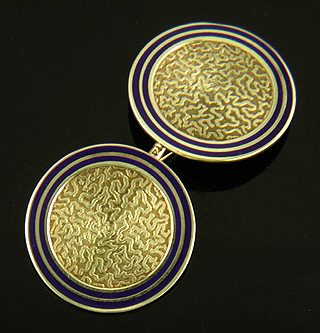
Larter "squiggle" cufflinks with dark blue enamel borders.

Enamel accents were added to cufflinks using an ancient technique known as "champlevé." Under this technique recesses were carved or cast into the upper surfaces of the cufflinks. Then, vitreous enamels in the form of glass powder were fired in the recesses. The recesses served to both define the pattern of the enamel work and protect it. Once the cufflinks had cooled the surfaces were polished, creating a beautiful interplay between the colorful enamels and the precious metal.

For example, the Larter & Sons cufflinks pictured above feature a double border of deep blue enamel set between polished bands of gold. The unusual center pattern is a myriad of twisting forms, a design we have nicknamed "Infinite Squiggles". Larter had a knack for creating beautiful cufflinks with intriguing gold centers and striking enamel borders.


Larter "Blue and Gold" cufflinks, circa 1925.

Another example of Larter's virtuosity in creating beautiful cufflinks featuring richly detailed gold centers and dramatic enamel borders. The blue enamel borders frame stylized floral motifs. The radial symmetry of the design gives the cufflinks a mesmerizing kaleidoscopic effect. Crafted in 14kt gold around 1920.


Richardson black-and-white cufflinks, circa 1930.

In 1929 an exhibition of jewels in Paris challenged the early Art Deco penchant for vibrant, bold colors. At the exhibition striking all-white and black-and-white jewelry captured the imagination of designers and the public. During the 1930s jewels crafted in platinum or white gold were set with sparkling diamonds, black onyx, white pearls and shimmering dark enamels. These dramatic jewels came to define the striking elegance of the Art Moderne look.

Cufflink maker's were not immune to the emerging fashion. Pictured above and below are striking black-and-white cufflinks created by the Richardson Manufacturing Company during the 1930s. Crafted in 14kt white gold, they feature centers of jazzy, wavy lines surrounded by dramatic black enamel borders.


Richardson black-and-white cufflinks, circa 1930.

Founded by Enos Richardson in 1841, Richardson Manufacturing Company (originally Enos Richardson & Company) was one of the longest surviving American jewelry makers. Based in Newark, New Jersey, the firm created a broad range of jewels and accessories in silver and gold. The firm's striking black-and-white cufflinks from the Art Deco era are among the rarities of enamel cufflinks.


Keller Arts & Crafts cufflinks, circa 1910.

Another long-established American maker of fine cufflinks was Charles Keller & Company. Among the firm's creations were gold cufflinks accented with blue enamel designs. The cufflinks were crafted in 10 and 14kt gold and date from the early 1900s till the 1930s.

The cufflink pictured above dates from the Arts & Crafts period (circa 1910) and features a striking blue enamel border that anticipates the bold, geometric designs of the later Art Deco period. For further examples of Keller blue and gold cufflinks see my earlier note Keller Blues.


British engine-turned cufflinks, circa 1930.

Additional details of these and other fine antique cufflinks
can be found in the Antique Cufflink Gallery.