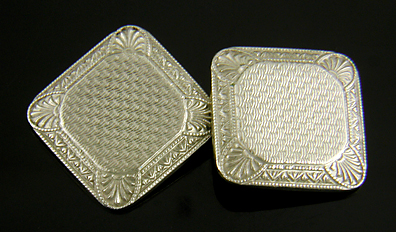
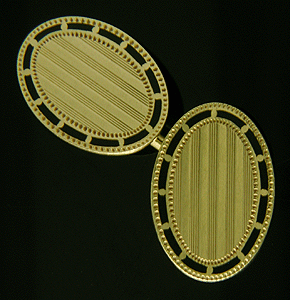
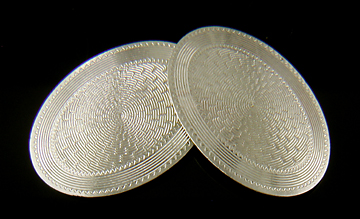
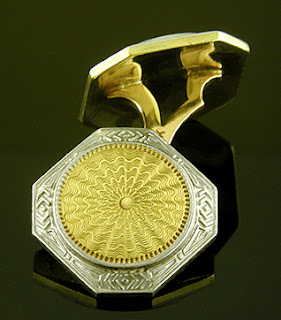
Sunday, January 31, 2010

The Artistry of Antique Cufflinks

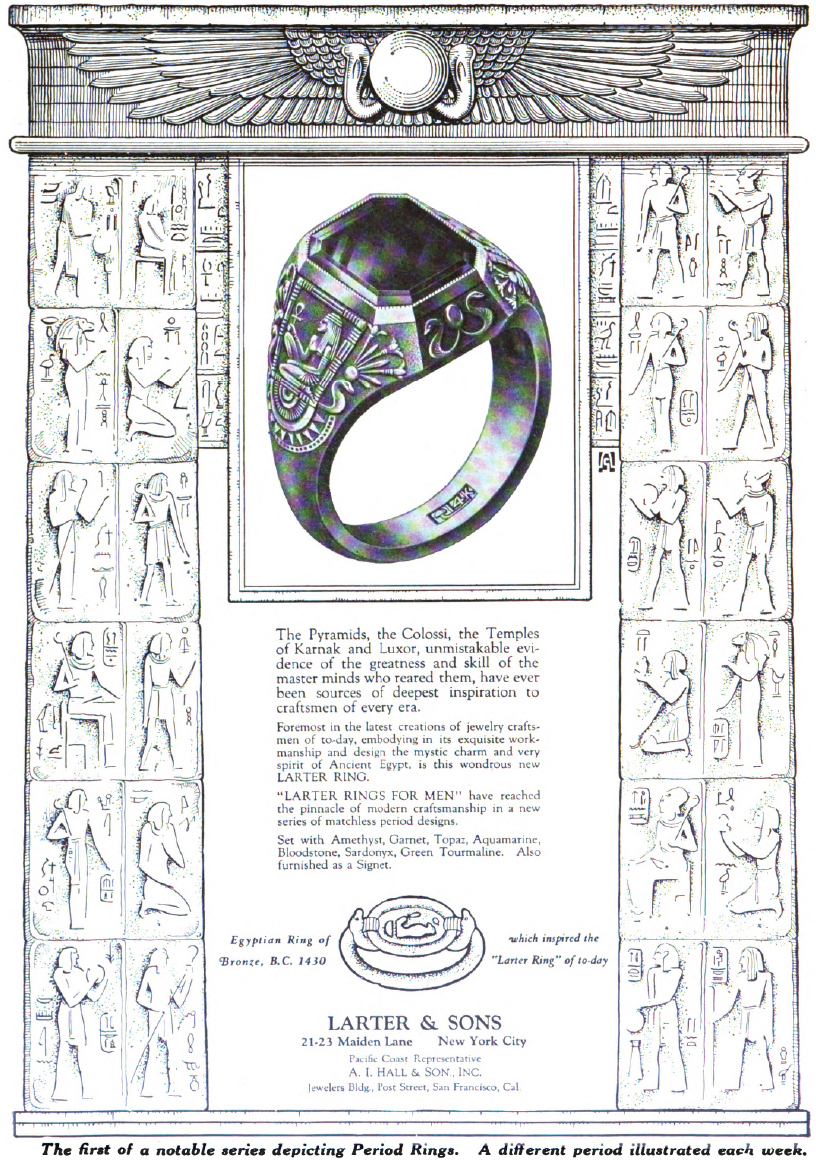
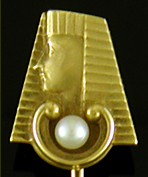
Egyptian Revival cufflink, circa 1890.

Every so often I am asked to explain the allure of antique cufflinks. What sparks the enthusiasm for these diminutive jewels from the past? What makes an attractive pair of cufflinks irresistible? In my experience three factors contribute to the appeal of antique cufflinks - Art, History and Adornment. Collectively, I refer of these three factors - Art, History and Adornment - as the "AHA effect".

Over the next several months I hope to discuss the factors that make up the AHA effect. Today I will focus on the first factor ... the artistry of antique cufflinks.


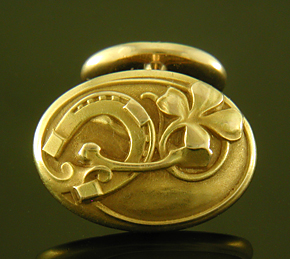
Art Nouveau cufflink, circa 1900

A friend of mine describes and displays his antique cufflinks as miniature works of sculpture. He refers to this array of cuff jewels as "the art collection." I am certain many cufflink collectors and admirers (myself included) feel the same way.


Intricate Scroll cufflinks in 14kt gold, circa 1900.

What initially attracts me to a pair of cufflinks is the beauty of the design and artistry of the workmanship. Assessing period, materials, maker and other interesting details takes second place to just viewing and enjoying the cufflinks as miniature works of art. A few of the miniature masterpieces that we have had the pleasure of working with in the gallery illustrate this note.


Jazzy spiral and scroll cufflinks, circa 1920.

The artistic ferment of the late 19th and early 20th century gave rise to a profusion of artistic directions and philosophies. Each influenced jewelry and cufflink design. In the first half of the 20th century, cufflink styles ranged from the historic revivals and enthusiastic eclecticism of the Victorian era to the Art Deco and Moderne designs of the 1930s and 1940s. Examples also reflect the visions of Art Nouveau, Arts & Crafts and Edwardian jewelers who enjoyed periods of ascendancy.


Striking Art Deco cufflinks, circa 1925.

The great diversity of cufflinks from the past assures that there is always a pair to suit almost any taste . There is always something new to discover and delight in. After years of collecting and trading, I still come across unexpected designs and enjoy the excitement of examining a beautiful pair of vintage cufflinks for the first time.


Carrington cufflinks anticipating the Op Art of the 1960s.

Additional photos and details of the cufflinks illustrated above
can be found in the Antique Cufflink Gallery.

Thursday, December 31, 2009

Happy New Year!

With the end of the year rapidly approaching Judi and I would like to thank everyone with whom we have shared, researched, traded and, most importantly, admired vintage cufflinks. Over the past year we have had the pleasure of working with friends, clients and cufflink lovers throughout the United States and in many countries around the world.

In fact, we recently passed an milestone of sorts. With a flurry of business from Australia, we have now worked with clients on every continent except Antarctica. If only the penguins would adorn their feathery tuxedos with vintage dress sets! We would have every continent covered!

Over the past few days I have made several attempts to organize my perpetually cluttered desk. In so doing I came across notes I made several years ago about a house Charles Carrington built in the 1880s. Since the holidays are a wonderful time to enjoy beautiful Victorian homes, I will finish the year with ....


The House Carrington Built

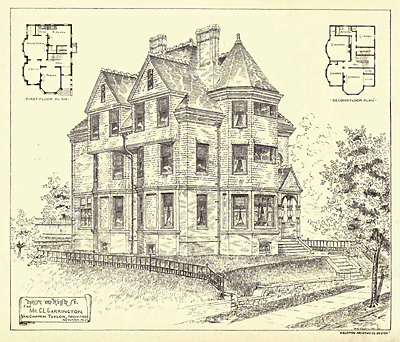
Locating and researching antique cufflinks takes you in many directions. Often you follow an unpromising lead or stray clue with surprising results. The following architect's rendering is one such discovery.

Please click the above rendering for a larger view.

The rendering is of a house built by Charles L. Carrington in 1885. I believe, but have not substantiated, that this is the same Charles Carrington who in 1891 formed a partnership with Alfred Mayhew for the manufacture and sale of fine jewelry. In 1900 this firm became Carrington & Company. As faithful readers of this blog and visitors to the Antique Cufflink Gallery are aware I have a great fondness for the cufflinks and dress sets created by Carrington & Company.

The plan was published in the August, 1885 edition of the American Architects and Building News. An accompanying paragraph notes:


House for Mr. Charles L. Carrington, Newark, N.J.
Mr. Van Campen Taylor Architect

The house is now in course of erection on one of the principal residence streets of the city. The first story will be built of North River brick, laid in red mortar, with Belleville stone trimmings. The second story, etc., will be of frame shingled with cedar shingles. The roof will be slated. The interior will be finished with painted walls, tiled fireplaces and hard-wood stairs and mantels. The cost will be about $12,000.

It is clear Mr. Carrington was quite successful even before the founding of Carrington & Company. The care and quality that he brought to making Carrington cufflinks is also evident in the house he built.


Judi and I hope everyone enjoys a peaceful and joyous New Year!


Monday, November 30, 2009

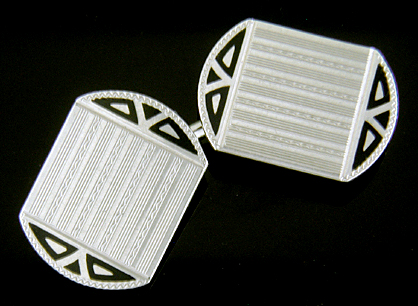
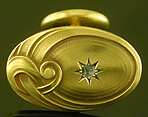
Art Deco white gold cufflinks, circa 1920.

Snowflake Cufflinks

Several nights ago a few isolated snowflakes fell as I was walking the dog. Meanwhile, the constellation Orion was peaking up over the horizon. All signs of winter. It is once again time to celebrate the coming season with a flurry of snowflake cufflinks.

The term "snowflake" is commonly used to describe white gold or platinum cufflinks that shimmer with exuberantly engraved designs. Particularly popular in the decades around 1920, these sparkling cuff jewels capture the light hearted, optimistic spirit of the age. The variety of intricately engraved patterns that decorate snowflake cufflinks is phenomenal, almost as varied and unique as natural snowflakes. The dramatic white gold Art Deco cufflinks pictured above are a nice example.

Here are a few more snowflakes that recently blew into the gallery ...


WAB jazzy spiral and scroll cufflinks, circa 1920.

Wordley, Allsop & Bliss was one of the more prolific makers of fine cufflinks from the firm's founding in 1907 until the 1930s. WAB and its successor firms created cufflinks ranging in style from late Victorian to late Art Deco Moderne. These white gold cufflinks from the early 1920s feature jagged spiral centers surrounded by richly scrolling borders. They reflect the early Art Deco preoccupation with leaving no surface undecorated.


Link & Angell barley turned cufflinks, circa 1920.

Link & Angell was another maker of fine cufflinks during the early decades of the last century. These beautifully engine turned cufflinks are decorated in a pattern known as "barleycorn". The repeated, petal-like design and the frostiness of the white gold, inspired us to nickname these cufflinks "Winter Rose". Crafted in 14kt gold around 1920.


Wintry Art Deco diamond cufflinks, circa 1925.

These frosty white gold cufflinks always remind me of a field of freshly fallen snow in the winter moonlight. The shimmering white of the the gold and richly detailed engraving give the cufflinks a sparkling, almost crystalline appearance. A small diamond set in a navette setting adds to the wintery brilliance. Crafted in 14kt white gold around 1925.


Ziething "Radiating Wave" cufflinks, circa 1925.

The word "pizazz" could have been invented to describe the jazzy cufflinks created by Ziething & Co. during the 1920s. The firm excelled at creating dramatically engraved cufflinks that seem to radiate, not just reflect, light. This pair with radiating wave-like centers surrounded by dramatic track borders is a beautiful example. Crafted in 10kt gold, circa 1925.


To view these snowflake cufflinks and other elegant cufflinks,
please visit the Antique Cufflink Gallery.

Friday, October 30, 2009

George O. Street Cufflinks

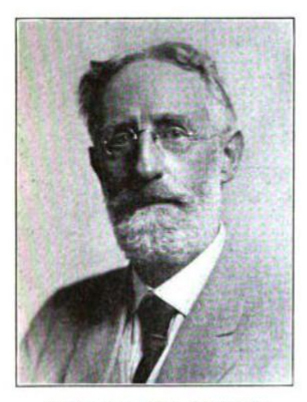
George W. Street, circa 1900

A great variety of fine cufflinks were created in the decades near 1900. Styles ranged from Victorian to Art Nouveau, Arts and Crafts to Art Deco. One of the firms contributing to the melange of miniature cuff masterpieces was George O. Street & Sons.

In 1837 George Street established one of the first jewelry manufacturers in the United States. Located in lower Manhattan the firm created gold rings, seals, watch fobs and other jewels for the carriage-trade jewelers of the day, including Tiffany & Company. In 1892 George Street retired to the family manse in Great Barrington, Massachusetts and passed leadership of the firm to his son George W. Street (pictured above). The firm remained in business until about 1950. Of particular interest are the beautiful gold cufflinks created under the leadership of the founder's son in the years around 1900.


George O. Street Celtic Revival cufflinks, circa 1900.

George O. Street cufflinks are miniature works of art finely crafted in gold. The firm's artists and craftsmen excelled at exploiting golds sculptural potential, creating gold cufflinks with dramatic shapes, intricate designs, and subtle textures. The gold was an integral part of the design - not just a bright setting for gemstones or a shiny surface to be elaborately engraved.

The above Celtic Revival cufflinks featuring intricately interwoven knotwork (plaits) are a wonderful example. The endless knots fill the inner borders of the cufflinks and encircle raised oblong centers of brightly polished gold. The subtle texture of the plaits and the natural patina of the precious metal throw the design into dramatic relief. Crafted in 14kt gold, circa 1900.


George O. Street Art Nouveau Cufflinks, circa 1900

The Puritan settlers of the New Haven Colony were among the Street family's ancestors. No doubt their rigid sense of probity would have been offended by these Art Nouveau cufflinks created 250 years later by George O. Street & Sons. America had come a long way since the 1600s.


Close-up of "Nymph in Waves" cufflink.

Ocean nymphs enveloped in crashing waves and frothy seas were a classic Art Nouveau theme. Sometimes referred to as "Nymph in the Waves" or on the west coast "Surfs up, Nude", the risque scene was favored by makers and wearers of gentlemen's jewelry and accesories. These dramatic cufflinks beautifully illustrate the firm's ability to work with gold to create richly detailed miniature works of sculpture. The result is astounding when you consider that the cufflinks measure less than an inch across.


George O. Street Onyx and Gold Cufflinks, circa 1900

An example of the free flowing, organic forms of American Art Nouveau, the above cufflinks mysteriously glow with dark Onyx centers surrounded by undulating, spiraling gold borders. The upper surface of the gold is engraved with a subtle bark or snakeskin-like pattern. The contrast between the dark Onyx and warmth of the gold is heightened by the natural patination of the gold. For some reason, these cufflinks always remind me of a dark night sky lit by a few sparkling stars.

American Art Nouveau design was strongly influenced by Louis Comfort Tiffany, son of the founder of Tiffany & Company (another firm founded in 1837). George O. Street & Sons was a provider of gold rings and other jewels to Tiffany & Company. Although Tiffany & Company created it own cufflinks, the firm also retailed cufflinks from other noted makers of the day - including Carrington and Krementz. I suspect that George O. Street & Sons also provided cufflinks to Tiffany & Company. An interesting area of further research is the shared history of the two firms and possible interactions between the sons of the founders.


Reverse of George O. Street Cufflinks, circa 1900

George O. Street & Sons created beautiful jewelry and cufflinks from 1837 to about 1950. During that period the maker's mark of the firm was an "S" encircled in an oval. Found on the reverse of the cufflinks, the maker's mark preceded, or sometimes split, the gold purity mark.

George Street Maker's Mark.

To view these and other elegant cufflinks from the past,
please visit our Antique Cufflink Gallery.


Wednesday, September 30, 2009

American Art Nouveau Cufflinks

Art Nouveau Cufflinks, circa 1900

In the decade before 1900 exceptional artist jewelers sought a break with the traditions of the past. Finding inspiration in nature, distant cultures, and their own fertile imaginations, these innovative jewelers created stunning jewels that were known collectively as the "Art Nouveau."

Different nations contributed unique interpretations to the Art Nouveau style. In France artists like Rene Lalique created jewels with fantastic woman-insect hybrids and other exotic forms. In Germany the new art found expression in the sinuous, tendril-like curves of the Jugendstil ("youth style"). And in Great Britain Art Nouveau jewels and objects reflecting elements of Celtic and Arts & Crafts design were created by Archibald Knox for Liberty & Co.


Krementz Art Nouveau Cufflinks, circa 1900

In America jewelry and cufflink makers were quick to follow the emerging fashions in Europe. Krementz & Company was an early adopter of the the Art Nouveau style. The above Krementz cufflinks recall the flowing curves of the German Jugenstil and the dramatic illustrations of the British artist Aubrey Beardsley. At the top of this note is a beautiful pair of Link & Angell cufflinks likely inspired by the exotic Art Nouveau jewels created in France and the posters of Alphonse Mucha. The face and cascading hair of the woman are enveloped in the narcotic vapors of a poppy flower - a classic Art Nouveau motif.


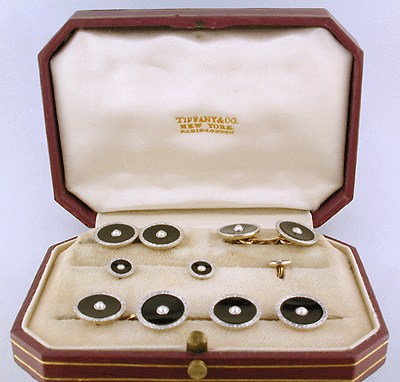
Tiffany & Co. Sapphire and Diamond Cufflinks circa 1900

However, Amercian Art Nouveau cufflinks did not just imitate of the latest European fashions. A unique style of Art Nouveau emerged in the United States. Louis Comfort Tiffany (son of the founder of Tiffany & Company) was a leading proponent of Art Nouveau design. Inspired by trips to Europe and participation in international exhibitions, he contributed a distinct American Art Nouveau style - one emphasizing nature and the imagination.

The above cufflinks created by Tiffany & Company are a wonderful example. The flowing, rich curves and organic forms of the cufflinks have the appearance of seaweed or aquatic plants floating serenely in the water. Voluptuous, flowing curves and tight swirls are emblematic of American Art Nouveau design.


George Street Onyx and Gold Cufflinks, circa 1900

A second pair of American Art Nouveau cufflinks featuring gently flowing borders with tight swirls. The gold borders are subtly textured to create a vine-like, or possibly reptilian, appearance. The swirls at each corner are reminiscent of shimmering stars on a slightly overcast or foggy night. The overall organic shape and drama of the borders is heightened by black Onyx centers and the natural patination of the gold. Created by George O. Street & Sons in 14kt gold, circa 1900.

Tiffany's work with art glass undoubtedly influenced his approach to Art Nouveau design. Indeed, the design of many American Art Nouveau jewels show a strong affinity with the voluptuous curves and curls that Tiffany created in glass. The Favrile glass punch bowl exhibited by Tiffany at the Paris Exposition Universelle in 1900 is a wonderful example.

The affinity between the jewels and the art glass of the period is not surprising. One of the tenets of Art Nouveau design was to create a unified environment in which all elements - architecture, furniture, decoration, objets d'art and jewelry - followed consistent design principles and themes. A movement away from the cluttered eclecticism of the Victorian era.


To view these and other elegant cufflinks from the past,
please visit the Antique Cufflink Gallery.

Monday, August 31, 2009

Guilloche Enamel Cufflinks

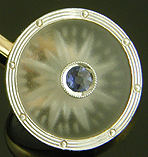
Carrington & Co. purple guilloche enamel cufflinks.

Among the rarities in the world of antique cufflinks are gold cufflinks decorated with guilloche enamel. In part the rarity stems from the expertise and time needed to craft these glittering masterpieces. As a result, relatively few were created. Also, over the years the broad enamel surfaces were susceptible to wear and scratches. So, even fewer pairs have survived. The purple and white enamel cufflinks pictured above are a fine example of guilloche enameling. They were crafted by Carrington & Company in 14kt gold around 1920.

Guilloche enamel brings together two ancient and exacting arts - enameling and engine turning. Enameling is the art of fusing powdered glass on metal to create a hard, vitreous surface. The glass can be clear or colored, transparent or opaque. Examples of enameled jewels have been found among the ruins of the ancient Mycenaean civilization on Cyprus. The ornaments (sorry, no cufflinks) date from the 13th century BC.


Link & Angell dramatically engine-turned cufflinks.

Engine turning (or guilloche) is the art of engraving intricate, repeating patterns on a metal or ivory surface. The common guilloche designs include radiating stars, wavy lines, intricate spirals and concentric circles, ovals and other figures. The Link & Angell cufflinks pictured above are a nice example of the engine turners art. These cufflinks are named "Winter Rose" because of the beautiful radiating petal-like pattern and frostiness of the white gold. They were crafted in 14kt gold around 1920.

When an engine turned surface is covered with a layer of transparent colored enamel (i.e., guilloche enameling) magic occurs. The colored enamel pools in the valleys of the engraved lines adding rich color where the engraving is deepest. Subtle gradations in the intensity of the color highlights the design and throws the pattern into almost three dimensional relief. The effect is mesmerizing.


Carrington blue-gray guilloche enamel cufflinks, circa 1910.

The enthusiasm for guilloche enameling during the late 19th and early 20th century was sparked by the creations of the master Russian jeweler Peter Carl Faberge. Faberge and his workmasters created a dazzling array of enameled jewels and objets d'art. In doing so they elevated the arts of engine turning and enameling to new heights. Among Faberge's many enameled creations were cufflinks, desk accessories and the famous Faberge Easter Eggs.

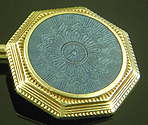
The above Carrington cufflinks may have been inspired by Faberge's work. The subdued blue-gray enamel and classic canted-corner shape of the cufflinks recalls the elegant jewels of the Russian master. They illustrate the simple, elegant designs favored by Carrington & Co. and the firm's uncompromising commitment to craftsmanship. Crafted in 14kt gold, circa 1910.


William Huger blue guilloche enamel and gold cufflinks.

Equal to Carrington & Co. in creating beautiful guilloche enamel cufflinks was William Huger & Company. Of the two firms Carrington was the more prolific. But what Huger lacked in numbers the firm made up for with the beauty of its cufflinks.

The above Huger cufflinks feature light blue enamel over an intricately engine-turned pattern. The guilloche design brings to mind the fanned tail of a peacock. When wedded with the blue enamel the effect is like exploding blue fire works in a clear evening sky. The enamel centers are framed with gold borders of foliate and geometric scrolls. Crafted in 14kt gold, circa 1920.


To view these and other elegant cufflinks from the past,
please visit our Antique Cufflink Gallery.

Friday, July 31, 2009

Curvaceous Cufflinks

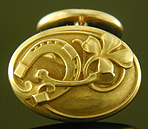
Sapphire and entwined heart cufflinks, circa 1900.

In the years around 1900 cufflinks and jewelry took a new turn. In fact, cufflink designs took a great many turns as fin de siecle jewelers and jewelry lovers embraced sinuous, intertwining curves. The dramatic whiplash curves of Art Nouveau designs, the intricate interwoven curves of ancient Celtic art, and sinuous serpents and flowering vines can all be found embellishing cufflinks of the period. A few of these curvaceous cufflinks are illustrated below.


Late Victorian serpent and vine cufflinks.

Sinuous entwined snakes and clematis vines decorate these late Victorian cufflinks. The Victorians loved jewels with hidden message and secret meanings. Intertwined or coiled snakes were considered a symbol of good fortune and eternal love. Clematis was a symbol for ingenuity. Perhaps the secret message of these cufflinks is that a long relationship or marriage takes both luck and ingenuity. Crafted in 14kt gold by Krementz & Company, circa 1890.

Celtic Revival cufflinks crafted in 14kt gold.

In addition to nature - snakes and vines - Victorian jewelers also drew inspiration from ancient civilizations and past cultures. Often sparked by archaeological discoveries, the Victorians enjoyed a seemingly endless parade of Egyptian, Classic, Etruscan, Roman, Viking, Celtic, Gothic, Medieval and Renaissance Revivals.

In the 1890s Archibald Knox working with Liberty & Company drew upon the intricate curvilinear designs of ancient Ireland. Knox's work inspired other designers and blossomed into the Celtic Revival. Beautiful jewels and objects were inspired by the interlaced motifs of the ancient Celts. The cufflinks illustrated above are a wonderful example. Crafted in 14kt gold by George Street & Sons, circa 1900.


Krementz & C0. Art Nouveau cufflinks.

Art Nouveau design could be described as curves unbound. While Art Nouveau jewelers also found inspiration in the sinuous forms of nature, they added imagination and fantasy to create never-before-seen jewels. The bold, exotic curves of Art Nouveau jewels are less restrained and more free flowing than in jewels of the late Victorian period.

The above cufflinks, created by Krementz & Co. around 1900, illustrate the new taste for dramatic curves and asymmetric design. Krementz was one of the leaders in introducing Art Nouveau design to the United States. You can find more about Krementz and the Art Nouveau in my earlier post Art Nouveau Cufflinks


To view these and other cufflinks from the past,
please visit our Antique Cufflinks Gallery.