Showing posts with label Newark. Show all posts

Saturday, July 31, 2010

Cufflinks in the Garden


Larter & Sons grape vine cufflinks, circa 1900.

Cufflinks in the Garden

I have been enjoying a short, sporadic vacation recently, so this note may be a little disorganized and uncharacteristically brief. One of the areas neglected during my absence (besides blog posting) has been the garden. Despite the neglect, it has been a glorious season for the flowers with the Full Moon Coreopsis in full bloom and the Ruby Dwarf Helenium coming into its own. With the garden on my mind it is appropriate to post several pairs of antique cufflinks featuring flowers and plants.


Chrysanthemum and vine cufflinks, circa 1910.

A riot of wild chrysanthemums flourishes across these eight-sided cufflinks, a scene that recalls the Japanese woodcuts of the 1800s. The influence of Japanese art on Art Nouveau design can be seen in the flowing tendrils and vines that curl like wind-blown wisps of smoke between the flowers. Within the small area of the cufflinks (less than 5/8" across) I count eight blossoms in various stages of bloom. Created by United Jewelers in 14kt gold, circa 1910.


Carrington rose and thistle cufflinks, circa 1920.

Carrington cufflinks with elegant rose and thistle borders. A client suggested that the rose-and-thistle motif may be a subtle celebration of Scottish-English unity, but I am inclined to believe that the design was chosen more for its beauty than any political allusion.

Initially, I described the centers of these cufflinks as radiant sunbursts. Now that I am in a floral frame of mind the centers appear more like dramatic flowers evocative of the stylized lotus blossoms and papyrus fronds of the Pharaohs or ancient India. Perhaps a reader with greater knowledge of the flora and iconography of the ancient world can shed some light. These eclectic cufflinks were crafted by Carrington & Company in 14kt gold, circa 1920.


Larter & Sons 14kt gold acanthus leaf cufflinks, circa 1900.

In the early 1900s, the Newark-based jewelry firm, Larter & Sons, created a wonderful collection Art Nouveau inspired cufflinks. The entwining grape vine cufflinks at the top of this post are a nice example. The acanthus leaf cufflinks pictured here further illustrate the firm's ability to create dramatic cufflinks with flowing, organic designs. The acanthus leaves appear to be slowly encroaching across the gently domed surface of the cufflinks. Created by Larter & Sons in 14kt gold, circa 1900.


Larter & Sons acanthus leaf cufflink, circa 1900.


To view these these and other fine antique cufflinks,
please visit the Antique Cufflink Gallery.

Friday, April 30, 2010

Moss Agate Cufflinks


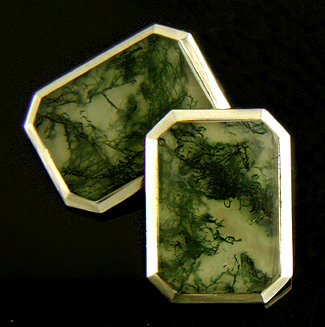
Carter, Howe Moss Agate Cufflinks, circa 1900.

Moss Agate Cufflinks

Over the last several weeks Spring has arrived in southern New Hampshire. The tulips are up, the lilacs are in bud and the wisteria is about to blossom. This explosion of color in the garden brings to mind one of my favorite gemstones found in antique cufflinks - Moss Agate.


Moss Agate is a beautiful variety of fine grained quartz shot through with green or earth-tone inclusions. This alluring gemstone is found in several flavors. Montana Moss Agate is a translucent milky white speckled with dark inclusions resembling small patches of moss or lichen. Another variety, Mocha Stone, was favored during the Victorian era. Mocha Stones were often set in cuff buttons and watch fobs and feature fantastic dendritic forms resembling the spreading branches of a miniature tree.


Carter, Howe Octagon Moss Agate Cufflinks, circa 1900.


However, the Moss Agates favored by cufflinks makers in the early 1900s are best described as "Seaweed" Agates. These beautiful gemstones have the mesmerizing appearance of green seaweed floating in a sunlit pool. When backed with mother-of-pearl or other white material and set in yellow gold, the effect is striking.


Carter, Howe Moss Agate Cufflinks, circa 1900.


Among the premier makers of elegant cufflinks and dress sets in the early 1900s was Carter, Howe & Company (Carter, Gough & Company after 1915). The firm created a dazzling array of cufflinks and dress sets featuring Moss Agates set in 14kt gold. Pictured above are several fine examples.


In the early 1900s, the firm appears to have specialized in creating fine cufflinks featuring unusual gemstones. Examples can be found set with Bloodstones, Onyx, Moonstones and other exotic gems. These lesser known gemstones were sometimes erroneously referred to as "semi-precious gems" - a misnomer belied by the beauty of the cufflinks in which they were set.


S&N Moss Agate Cufflinks, circa 1920.


Another firm that worked with gemstones beyond the traditional sapphires and diamonds was Sansbury & Nellis (S&N). Like many of the fine cufflink and jewelry makers of the day (including Carter, Howe), Sansbury & Nellis was based in Newark, New Jersey. From the style of its cufflinks and notices in the trade press, the firm appears to have operated from about 1900 until the 1930s. Pictured above is a beautiful pair of Sansbury & Nellis cufflinks featuring oval Seaweed Agates. The gemstones have nicely bevelled edges and are set in bright yellow gold. A nice example of the firm's work.


To view these and other beautiful antique cufflinks
please visit Antique Cufflink Gallery.


Saturday, January 31, 2009

William Huger Cufflinks


William Huger blue guilloche enamel and gold cufflinks, circa 1920.

William Huger Cufflinks

William Huger & Company was not as large or prolific as some of the other fine cufflink makers of the early 20th century (e.g., Carrington and Wordley, Allsopp & Bliss). But what it lacked in size and numbers, the firm made up for with the beauty and craftsmanship of its cufflinks. William Huger cufflinks are sought both for their great beauty and rarity.


William Huger & Co. gold cufflinks, circa 1900.

The story of William Huger & Company is yet to be fully told: the historical record is sparse. The firm was based in Newark, New Jersey and appears to have created fine gold cufflinks and other jewels for only a few decades from the late 1890s until the early 1930s. Like many fine jewelry makers based in Newark, William Huger & Co. ceased operations during the economic turmoil of the Great Depression.


Wm. Huger & Company gold cufflinks, circa 1920.

The greatest source of information about the firm are the cufflinks, themselves. William Huger embraced the best of late Victorian, Edwardian and Art Deco design. The cufflinks usually feature bold, arresting centers surrounded by refined, exquisitely detailed borders. The cufflinks were crafted in 14kt gold and often accented with enamels (like the beautiful cufflinks featuring blue guilloche enamel pictured at the top of this post) or gemstones.


William Huger Onyx and gold Art Deco cufflinks, circa 1930.

Elegant simplicity defines Huger cufflinks during the Art Deco period. The cufflinks above feature gently domed black Onyx centers surrounded by rich 14kt gold borders of geometric Art Deco motifs and reeded sections. William Huger excelled at combining the boldness of Art Deco design with the firm's high craftsmanship and attention to small details.


"Architectural Elegance" by William Huger, circa 1930.

We have nicknamed this particular Huger design "Architectural Elegance." It is reminiscent of the Chrysler Building and other architectural icons of the Art Deco era. Relative to other Huger cufflinks, this design is not quite as rare. I suspect it was one of Huger's more popular cufflink designs during the 1920s and 30s. Crafted in 14kt white gold, circa 1930.


William Huger & Co. maker's mark.

The maker's mark for William Huger & Company is an "H" with curling edges. The mark is found on the reverse of cufflinks to the right of the precious metal mark ("14" for 14kt gold). The Huger mark is sometimes misread as a fancy "K" or the somewhat similar maker's mark of the Clark Ring Company. At times the Huger mark may be partially obscured because of wear.


To view these and other fine cufflinks from the past,
please visit our Antique Cufflink Gallery.


Friday, October 31, 2008

The Cufflink Makers - Wordley, Allsopp & Bliss


The decades around 1920 have been nicknamed the Gold and Platinum Age of Cufflinks. In America jewelry makers, many based in Newark, New Jersey, created beautiful cufflinks in a great diversity of styles and in precious metals ranging from silver to platinum to gold. One of the more prolific makers of fine cufflinks during this period was Wordley, Allsopp & Bliss (WAB).


WAB Egyptian Revival cufflinks in 14kt gold, circa 1910.

Founded in 1909, WAB and its several successor firms created elegant cufflinks that drew upon and updated the historical revival styles of the Victorian era. WAB cufflinks were beautifully crafted in 14kt yellow and white gold and often rivaled the creations of the other preeminent cufflink makers of the period (such as Carrington & Company, Carter, Gough & Company and Wm. Huger & Company).

Pictured above is a WAB cufflink in the Egyptian Revival style with stylized lotus blossoms and papyrus fronds in a cruciform arrangement. The beveled edges of the cufflinks are highlighted with an exotic zigzagging meander of black enamel. WAB excelled at balancing an eclectic array of elements in their cufflinks without the design looking overly cluttered.


WAB Scroll and Garland 14kt gold cufflinks, circ a 1920.

The eclectic enthusiasm of WAB is nicely illustrated in these "Scroll and Garland" cufflinks set with striking cabochon-cut Sapphires. Exuberant S-scrolls dominate the cloisoned borders while classically inspired garlands fill the centers. The WAB cufflink designers successfully infused these historical motifs with the fun and pizazz of the 1920s. Sort of 18th century formalism meets Jazz.


WAB Pinstripes and Gold cufflinks, circa 1920.

Of course, not all WAB cufflinks were embellished with intricate designs. The pair pictured above is the epitome of simple elegance. The design reflects the simpler linear and geometric designs of the Art Deco period. The borders are accented with black enamel. This particular pair was given to a graduate of Brown University in 1920.

I believe WAB made cufflinks from about 1910 until sometime in the early 1930s. Like many cufflink makers of this period, production appears to have ceased or at least curtailed during the Great Depression. The firm was eventually absorbed by Krementz & Company during the 1950s.


Wordley, Allsopp and Bliss maker's mark.

The most common maker's mark for WAB and its successor firms is a "W" and a "B" resting on the sloping sides of an "A". The maker's mark is usually stamped along with the purity of the gold on the cross bar or bridge of the cufflink.


More photos of the above cufflinks can be found in the
Antique Cufflink Gallery.


Saturday, May 3, 2008

Surand & Co. cufflinks.Durand & Co. platinum and gold cufflinks, circa 1910
Durand was one of the many jewelry makers
based in Newark, New Jersey
.


Three Books and a Museum

As the temperature climbed above 80 degrees last week, my thoughts turned to summer. Two of my favorite summertime activities are reading by the lake and visiting the air conditioned confines of museums. So here is a list of several of my favorite cufflink-related books and one of my favorite museums.


The Glitter & The Gold: Fashioning America's Jewelry by Ulysses Grant Dietz, et al

During the decades from 1850 to 1950, Newark, New Jersey was the center of fine jewelry manufacture in the United States. The majority of the cufflinks featured in the Antique Cufflinks gallery and this blog were designed and manufactured by Newark jewelry makers. In 1997 an exhibition at the Newark Museum explored the history and evolution of the Newark jewelry trade and the stunning jewels created. The Glitter & the Gold documents the exhibition and offers many wonderful pictures and informative essays. If you are interested in American cufflinks and jewelry this book is indispensable.


Cufflinks by Susan Jonas and Marilyn Nissenson

This is a fun book. It tells the story of gorgeous cufflinks and the fabulous people, le beau monde, who wore them. The book presents a sampling of fine links from the early 1700s through 1990 with an emphasis on early 20th century and Art Deco examples. The book is beautifully illustrated with wonderful photographs. This is a great read for an afternoon at the beach.


Cuff Jewelry: A Historical Account for Collectors and Antiques Dealers by Howard L. Bell

While the Jonas book samples the history of fine cufflinks, this book goes into greater depth on a narrower range. Howard Bell illustrates cufflinks from the Victorian era to the 1960s with over 1000 images. He covers diverse topics such as historical periods, materials, methods of manufacture, gemstones and makers' makers. His Chronology of Linkages is particulary interesting. Published in 1994, the book's price estimates provide a useful benchmark for how antique cufflinks have appreciated over the past 15 years. This book is a useful resource for the aspiring cufflink collector.


The Newark Museum Newark, New Jersey

An opportunity to visit The Newark Museum should never be passed up. The museum has a wonderful collection of American jewelry and decorative arts from the 19th and 20th centuries. The Museum's Curator of Decorative Arts, Ulysses Grant Dietz, has organized a number exemplary exhibitions on jewelry and related arts. Mr. Dietz is also the lead author of the first book listed above. You should visit the museum's web site to learn of current exhibitions and special events ( http://www.newarkmuseum.org/ ).